

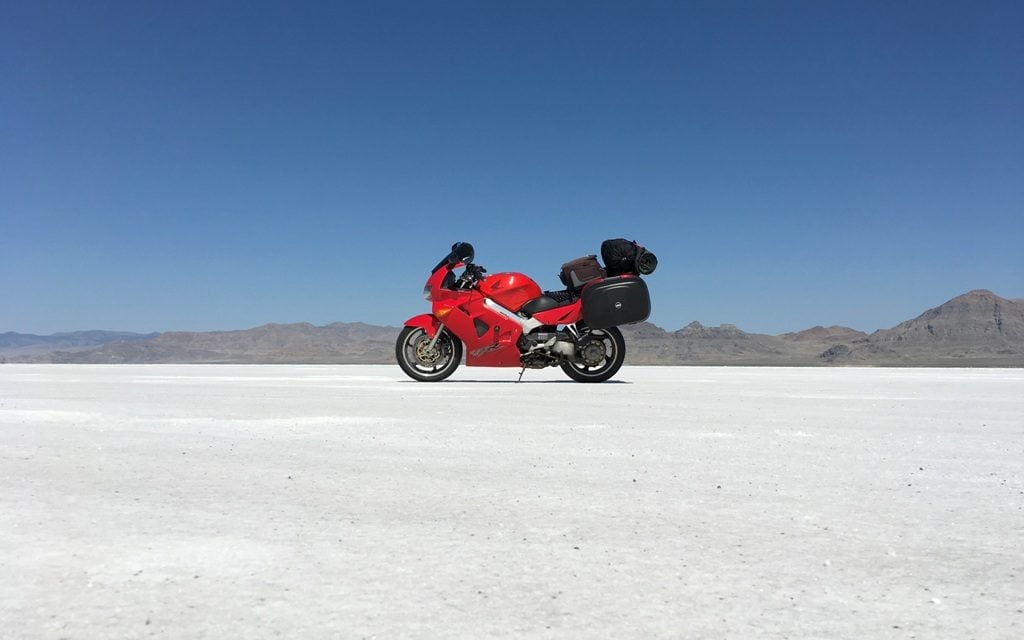

A math teacher breaks down the digits of a 143K-mileage 1998 VFR800
It’s a lot of miles for a motorcycle, 143,370 and climbing. Goldwing or BMW territory, these are not the miles you would expect from a 1998 VFR800. I decided to brew up some coffee, warm up my math and do a deep dive into what it has taken my VFR to rack up such big league miles.
You math nerds might find these fascinating.
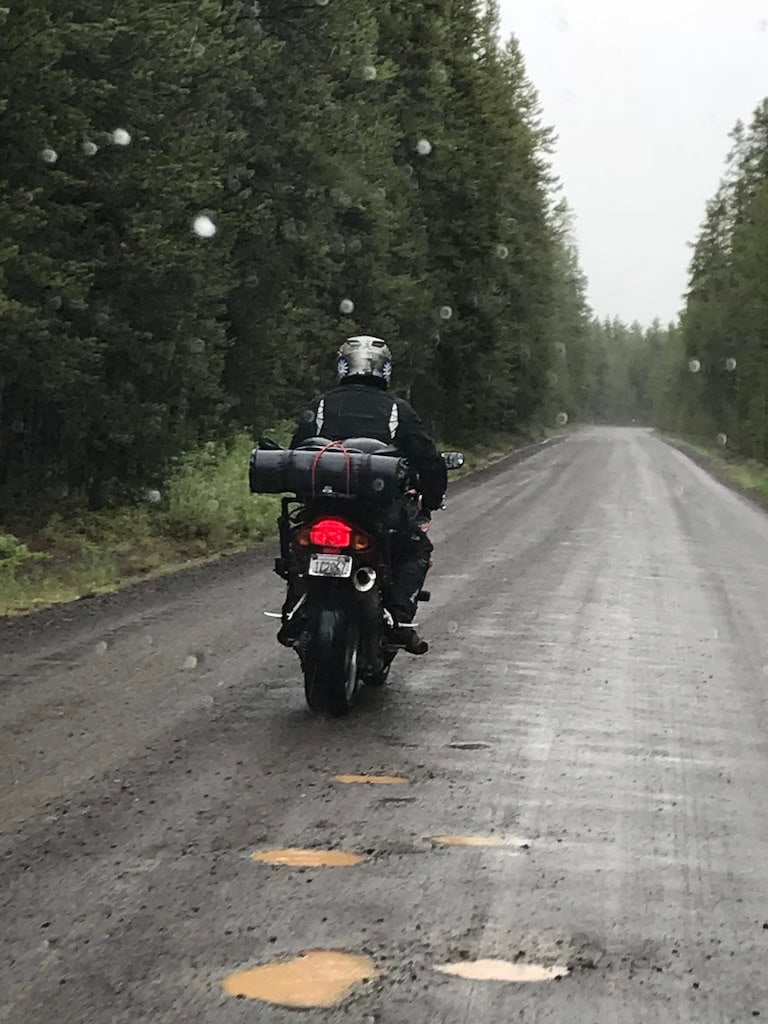
Big league miles means big league suffering. Leaving West Yellowstone in 2017, it was 45 degrees and driving rain, and a long, muddy ride to find pavement.
The circumference of the earth is about 24,900 miles, meaning the VFR has enough miles to have lapped the equator about 5.7 times and travel about 60% of the 238,000 miles required to make it to the moon. To get there, at about 40 miles per gallon, it has burned through 3,600 gallons of gas, all pumped out by the stock fuel pump. That is enough to fill a 14’ round above ground swimming pool, or about 21,600 lbs of liquid. Also, 3,600 gallons of gas at about $4 per gallon means it has consumed $14,400 worth of gas, or about 1.5 times more than the bike cost new.

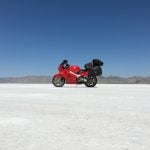
This is a photo of the spot where the VFR rolled over 100,000 miles. Some fast company came along to celebrate. Legally of course.
To add to that total, I have gone through at least fifty quarts of oil, five sets of chain and sprockets, five sets of brake pads, five batteries, one set of fairings, one stator, two voltage regulators, one clutch, about twenty sets of tires and six hundred thousand caramel frappuccinos. And that’s just what is visible. Deep in the belly of the motorcycle, parts are spinning and whirring, busily generating their own numbers.


Any bike is an adventure bike if you try hard enough. Ski rack was a factory option.
My rear tire is a 180/55-17. However, the 17” diameter is increased by the height of the tire which, having a 55% aspect ratio of its 180 mm width, gives a height of about 99 mm, or about 3.9 inches. Added to both sides of the 17 inch diameter means that the rear wheel diameter is a total of about 24.8 inches. At that diameter, multiplied by π, the rear tire covers 77.8 inches every time it rotates. My front tire has a 70% aspect ratio, but I will use the 77.8 inch number for each tire just for a rough, but very close, estimate.
Here comes the ridiculous.
A mile is 5,280 feet, or 63,360 inches. Dividing that number by the 77.8 inches my tires cover in one rotation means each tire makes roughly 814 revolutions per mile. Over the course of 143,370 miles, each of my tires has made about 116,703,180 revolutions. I will never complain about replacing tires, sprockets and wheel bearings so frequently ever again.

Road blocking cattle drives have become routine during our travels.
Let’s follow the rabbit farther down the hole.
The 6th gear ratio of a 1998 VFR800, at 30 teeth input to 29 teeth output, is about 1.035. The primary reduction ratio is 1.939 and running the stock 43 tooth rear and 17 tooth front sprocket gives a ratio of 2.529. Multiply all those reductions together (1.035 x 1.939 x 2.529) gives a total reduction ratio of about 5.07. This means that when in 6th gear the engine is making 5.07 revolutions for every one revolution of the rear tire.
Therefore, the crankshaft of my 1998 VFR800, at stock tire sizes and stock gearing, has spun a mind blowing 591,685,122 times. Half a billion turns of the crank. And that is assuming I use 6th gear every mile of my travels, which I don’t. The actual number is higher.
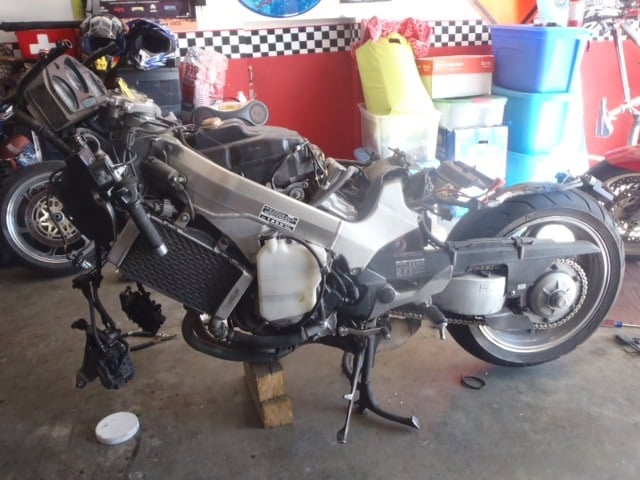
The bike had an “unfortunate incident” some years ago. A full teardown to frame and engine was a good opportunity to check everything.
For a deeper dive, I typically travel at 6,000 rpm in 6th gear. At 6,000 rpm, at a stroke of 48 mm, or 96 mm during its complete revolution, that piston is traveling 96mm x 6,000 rpm, or about 576 meters per minute. In an hour, that is 34,560 meters for an average of 21.47 mph. A piston traveling at 21.47 mph does not sound impressive, but when a piston traveling at that speed has to stop suddenly at TDC and begin its downward stroke, that translates to about 954 Gs (I had to look that one up). That peak G force is experienced twice per revolution of the crank, so each piston of the lovely V-4 has hit over 900 Gs about a billion times. I can barely fold a fitted sheet, much less design a piece of machinery capable of withstanding 900 times the force of gravity a billion times without fail.
Valves open once for every other turn of those roughly half a billion turns of crank so each valve of each of the four pistons has opened and closed 295,842,56 times. As a group, all 16 valves have executed a total of 4,733,480,976 perfectly timed activations. I have never checked the valve clearance. As my southern brothers might say over in Georgia, “If it ain’t broke, I ain’t fixin’ it.”

I wish I had a separate odometer for dirt miles. It’s a lot.
This VFR is a dinosaur, a fossil from an era when Honda over-engineered the VFR series with things like gear driven camshafts because they were Honda, and that’s what Honda did. When Honda North America reads this, if they ever do, they are welcome to take my precious VFR to their headquarters in Atlanta, Georgia or Torrence, California and disassemble it to see the internal toll of all those miles. I am curious what it looks like on the inside.
But they need to reassemble it and give it back. I am not done with it yet. As long as they adjust the valves.
Ted

Still accumulating miles.





















0 Comments