


The Myth and Mayhem of the West: A Desert Odyssey, Part III
The final lap of the long gallop found me once again in the beguiling Canyonlands. It keeps drawing me in with the promise of the never-before-seen. If you surrender, you may find yourself pointing your big street bike at a dirt hiking trail, leading you right into the abyss just to get closer to out there.
A 12-mile scenic drive runs from the visitor center out to Grand View Point with numerous turnouts and vistas. This is the Island in the Sky mesa, sitting 1,000-2,000 feet above the valley. The more popular overlooks include Grand View, Green River Overlook (faces west over the maze of canyons carved by the Green River; Mesa Arch (a .7-mile hike for the best view of the stone arch); and Upheaval Dome, perhaps the most intriguing sight. It certainly is a mystery. The circular crater-like depression is thought to be an impact crater or collapsed salt dome.
Let your imagination run with that one.
It never feels like enough time, but after three nights and a final scoot-about on the fourth day, I had to make some miles to Capitol Reef. North on 191, west on I-70, south on 24, passing by the eerie and foreboding Goblin State Park (a must-go), where countless spirits have been frozen in solid rock. Turning west to continue on 24 at Hanksville, the world changes. With names like The Castle, Golden Throne, Pectil’s Pyramid and curiously, Fern’s Nipple, towering buttes in shapes tortured and majestic line the road as if planted by some supernatural thing. They become more frequent as you ride. It’s hard to fight the temptation to stop everywhere and explore by boot. The life of a wandering desert hobo suddenly starts to feel like something you were born to do. Just be warned, it is very easy to get lost in the desert. Piles of bleached bones and desiccated leather jackets are found every year.
The underutilized park is perhaps my favorite jewel in the crown of the Mighty 5, southern Utah’s mind-bending, soul-changing national parks. Zion, Bryce, Arches, and Canyonlands complete the diadem. It is also the most remote. The nearest town is Torrey, the gateway to the park. Here you can find an accommodation or two, the Chuck Wagon General Store, a grocery, souvenir, breakfast and lunch place. Adjacent to the store sits a food truck, more like a food trailer, called Capitol Burger, which local lore has it serves the best burgers in the state, cooked personally by some fancy-pants chef who burnt out and retreated to tiny town life. The Torrey Trading Post and Cabins is across the street. The shop received five stars from 171 reviews. It’s worth a visit, especially if you like unique things and high-end, locally made knives and such. Cabins start at $75/night.
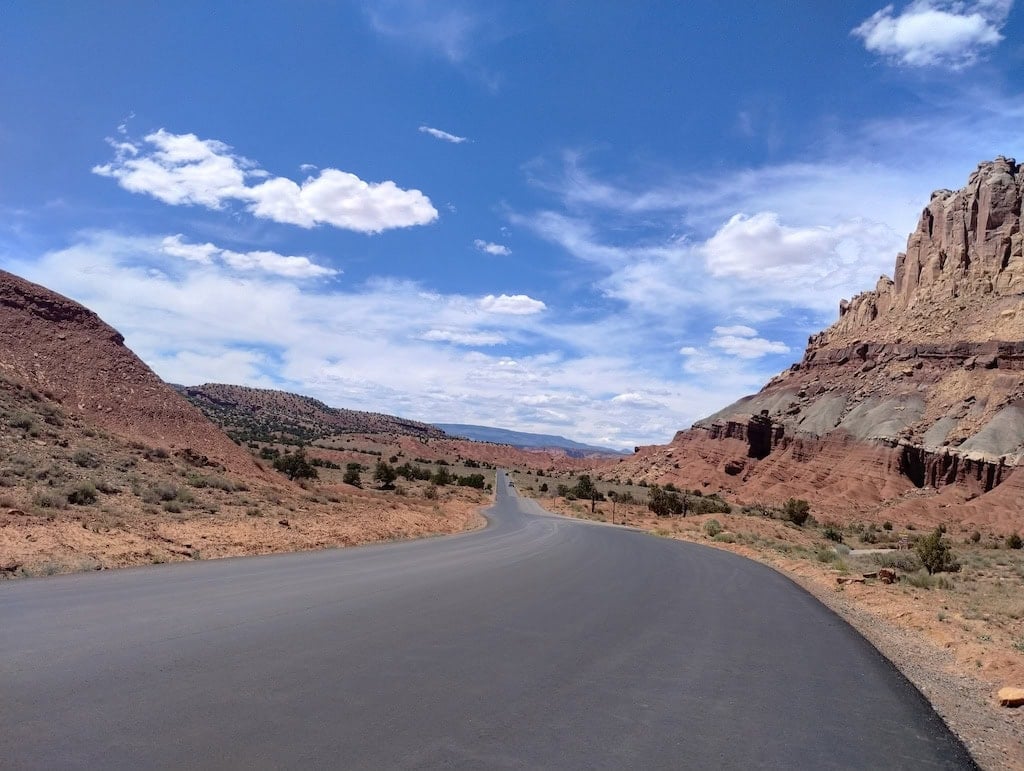
The road to Capital Reef
Just up the road from Torrey is the main entrance to Capitol Reef, which envelops a wrinkle in the earth called the Waterpocket Fold. Its geologic upheaval is marked by layers of golden sandstone, canyons and inspiring rock formations. Noted sights include Chimney Rock pillar, the Hickman Bridge Arch and Capitol Reef itself, recognized for its white sandstone domes. In the north side of the park reside the skyscraping monoliths of Cathedral Valley. Here, as in many areas of the Great American Southwest, there are a lot more dirt roads than paved. When I first saw this, I thought there was something wrong with my map. The primitive roads will vary from wagon train-like rough and rutted to loose sand. Some are doable on a street bike if you take it easy.
There is plenty to see, though, from the asphalt. From the main entrance, continue past the Visitor Center and pick up the Scenic Drive, eight miles of fresh asphalt through the interior. The pavement ends after that, rolling on in the dirt for a while. Of course, there are countless photo ops. The Fremont River runs through the park. High bacteria counts often make the water undrinkable, but it’s ok to stick your boots in to cool off if you like.
Backtracking some 30 miles to Hanksville, the next leg of the expedition requires a full tank of gas, a few bottles of water, a prayer book and blind faith your machine will survive 126 burning desert miles of no one and nothing. There is no cell service, but you may see deer crossing the road. And maybe a Bigfoot, or two. Pack a sandwich, too, and a pizza.
Once properly outfitted, turn left out of the Hanksville gas and snack station and ride south by southeast on Highway 95. Next stop, Blanding, UT. This is true motorcycling, something our biker ancestors did before civilization cursed us with fast food and quickie marts. Using your head, gathering your know-how and applying your specialized instincts will keep you alive on Route 95. It’s kind of an enhanced riding experience. It will also introduce you the Henry Mountains to the west; the Hite Crossing Bridge, which traverses the upper reaches of the Colorado River and Lake Powell and likely offers the most dramatic views from its overlook; Natural Bridges National Monument, Bear Ears National Monument; Mule Canyon Ruins and Cave Towers, once home to ancient Puebloans; Comb Ridge, an 80-mile fold in the earth’s crust (monocline); and Butler Wash Overlook, which leads to another Puebloan settlement and canyon overlook just before 95 spills you out at Blanding.
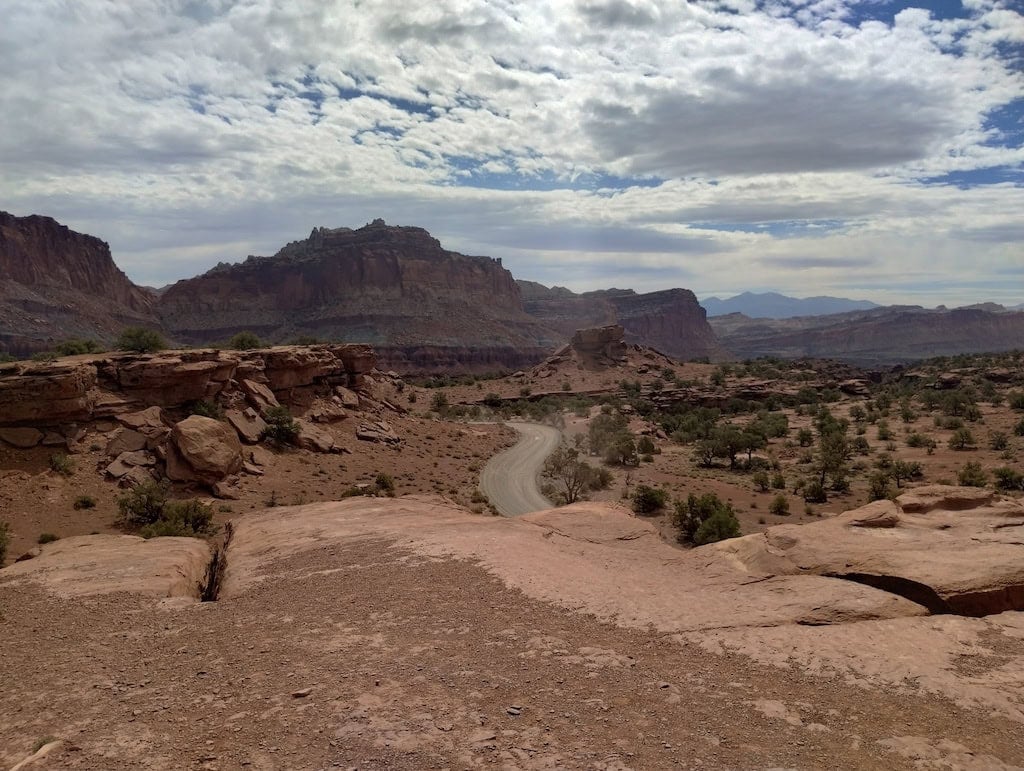
Beautiful desolation/isolation on the road from Hanksville to Blanding.
If you do nothing but just stay on the bike, you’ll love this road, but some of the stops are spectacular. The winds were howling when I pulled in for gas. The big Road King was bobbing a bit while I pumped premium into its gut. Blanding was just a place to bed down for the night and hope the winds blow themselves out by morning. There’s nothing to see here, the food isn’t good and there’s isn’t much of it. It was a good town to leave.
South on 95 toward Bluff and Medicine Hat, I took a break at the Bluff Fort Historic Site, a recreated Mormon pioneer village. Walk through the 1880s original and replica cabins, watch videos detailing the seemingly impossible Mormon migration here through impossible terrain, download a number of pioneer journals. There’s also a small restaurant and covered pavilion/picnic area. You can also pan for gold, for some reason.
I found it all surprisingly interesting.
When you’re in this part of the country, you have to stop at Monument Valley, ground zero for the Western mythos. Also known as Tsé Biiʼ Ndzisgaii in Navajo (valley of the rocks), it encompasses most of the Monument Valley Navajo Tribal Park. National Parks passes don’t work here; the area is on tribal land, managed by the Navajo.
You can drive your own car through the Monument Valley Scenic Drive, a 17-mile dirt road loop. Park admission is $10; cars cost another $15 for the loop. Jeep tours cost $65 to $70 per adult for a 1.5 hour tour; $65-$85 for 2.5 hours; $79-$95 for 3 to 3.5 hour cultural tours, usually including traditional music, storytelling and deeper cultural immersion. Sunrise and Sunset Tours are also available at a $5 to $15 added premium, as are half-day Extended and Mystery Tours, exploring petroglyphs and Anasazi ruins for $120-$220. Each jeep sets its own prices.
Motorcycles are not allowed down the loop road. This is probably a good thing. The road is rough with deep sand. Before it closed to bikes some years ago, I thought taking a big Moto Guzzi through the park would be fun. Had the wife on the back, it was a beautiful day, what could go wrong? I think you know. Some 17 miles of slipping and sliding and fishtailing later, the wife, who I generally thought of as fearless, decided to walk the last quarter mile, straight uphill. This experience may be why she is now my ex-wife.
All in all, a good day.
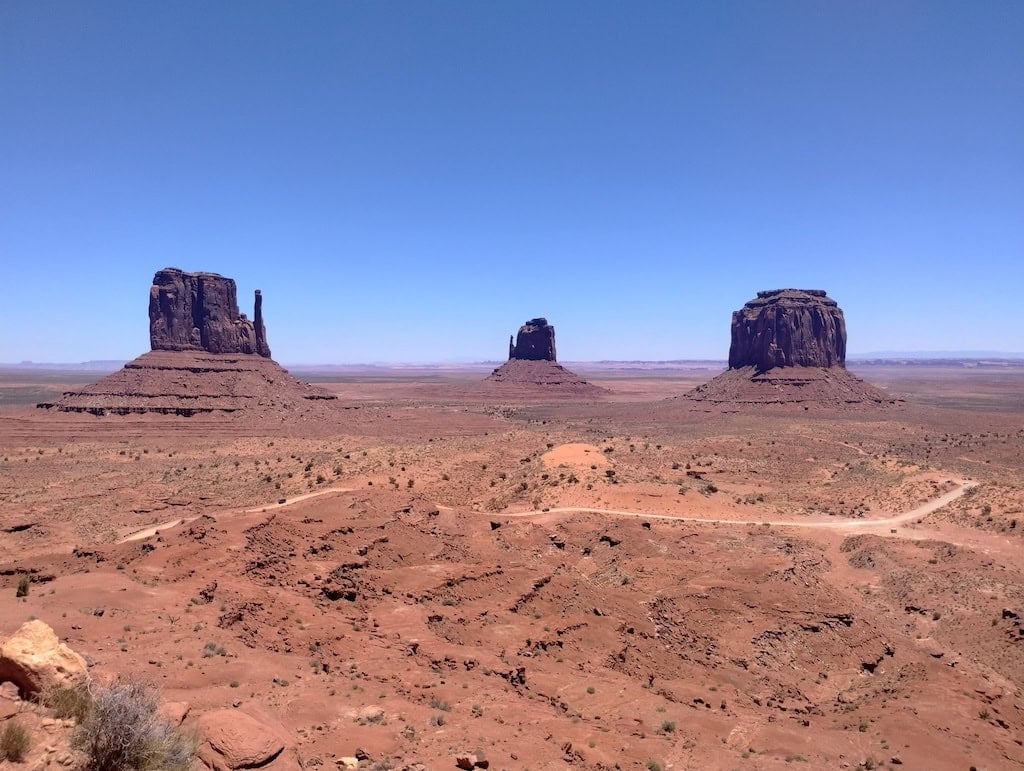
Glorious Monument Valley
Monument Valley’s majestic formations are familiar to most, particularly the infinitely photographed West and East Mitten Buttes. If you’ve ever seen Forest Gump, countless westerns and John Ford epics, you get the view. But being there is different. It feels like a holy place, and to the Navajo (Dine) Nation it is. It’s also arguably the birthplace of the American West narrative, at least on a grand scale. It was the perfect setting. Dramatic red rocks, harsh but majestic landscape, endless sky, ample room for imagination and myth creation.
If you have a paint brush, this is your blank canvas. Or a movie camera and piles of celluloid. John Wayne said after first seeing Monument Valley, “So this is where God put the West.” Zane Grey wrote the valley was, “…a strange world of colossal shafts and buttes of rock, magnificently sculptured, standing isolated and aloof, dark, weird, lonely.” I can’t imagine anything could better set the mood of the struggles, tragedies, loneliness, ever-present danger, loss and triumphs of the Old West. Ford shot nine films here and some might say he was filming a state of mind as much as a movie.
Of course, Ford’s work and all the B-movies that preceded it also launched stereotypes and cliches, mostly negative, some vicious. Good guys, bad guys, cowboys, Indians, the charging calvary, good vs evil, civilized vs “savage.” It served to make the settlers out to be rugged and heroic and often, innocent victims of the rampaging, primitive, Godless natives. Nothing could be further from the truth, but that’s not what made good box office.
The myths took on a life of their own, spawning countless books, movies and TV shows, creating composite personas in the form of legendary characters like Wild Bill Hickok, Wyatt Earp, and Kit Carson. These real people were fictionalized and sensationalized into the “western hero” and helped create a narrative of the Wild West that relied a lot on exaggeration and fiction. Add a public that, at least in part, believed them to be based in true history and we have our origin story. Of course, this is an oversimplification but you get the idea.
Personally, I’d rather just enjoy the view.
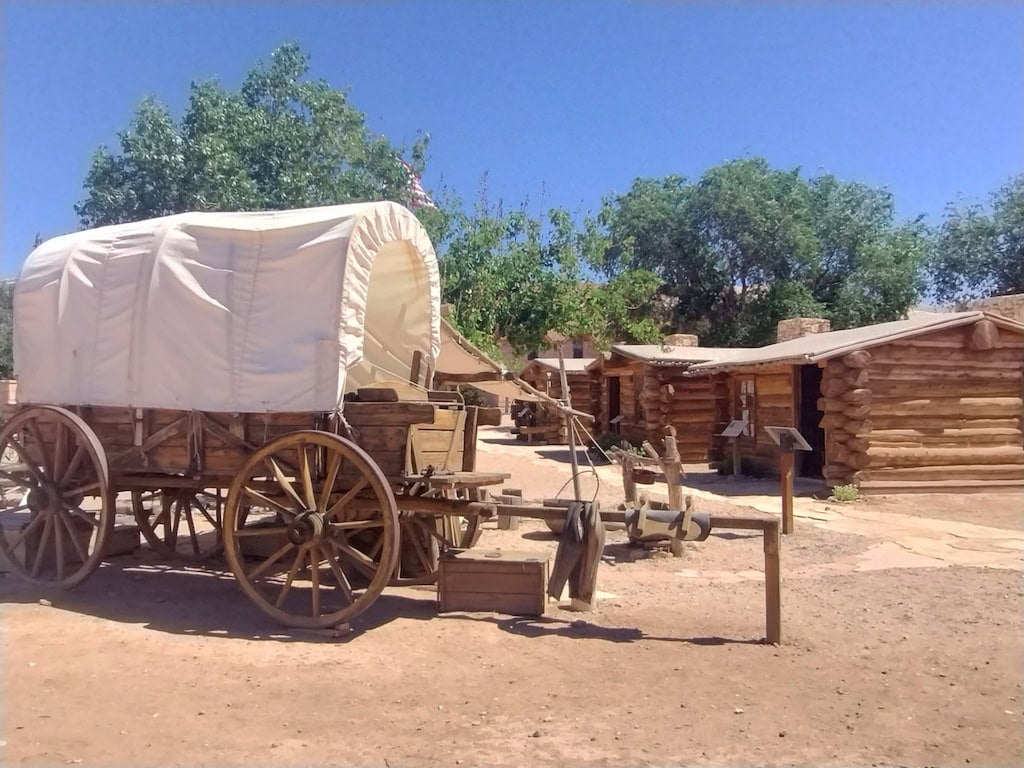
Bluff Fort Historic Site
The tribal park has a restaurant, 3-star hotel, and a gift shop that offers the expected souvenirs but also high-end jewelry, native-made signature knives, rugs, pottery, arts and crafts. Across from the park is the famed Gouldings Lodge, built in 1928. It’s a 3-star property with a quite good but casual restaurant. Try the Navajo Tacos.
Sadly, it was time to start making my way home, fighting the urge to carry on wandering the earth. Wyoming and Montana came to mind, but strangely, reason prevailed over road lust. Truth be told, after some three weeks in the saddle I was starting to tire of motel hopping. Perhaps on my next mission, maybe staying in one place for a while and seeing more of it, might be a nice change.
South from Monument Valley on 163, west from Kayenta on 160, northwest on 98 to Page, AZ. Couple of nights here to spin back through southern Utah via 89 west to Kanab, south then east down 89A, past the inconceivable Vermillion Cliffs, over the Colorado River courtesy of the Navajo Bridge, north back up 89 to form a scenic loop to Page.
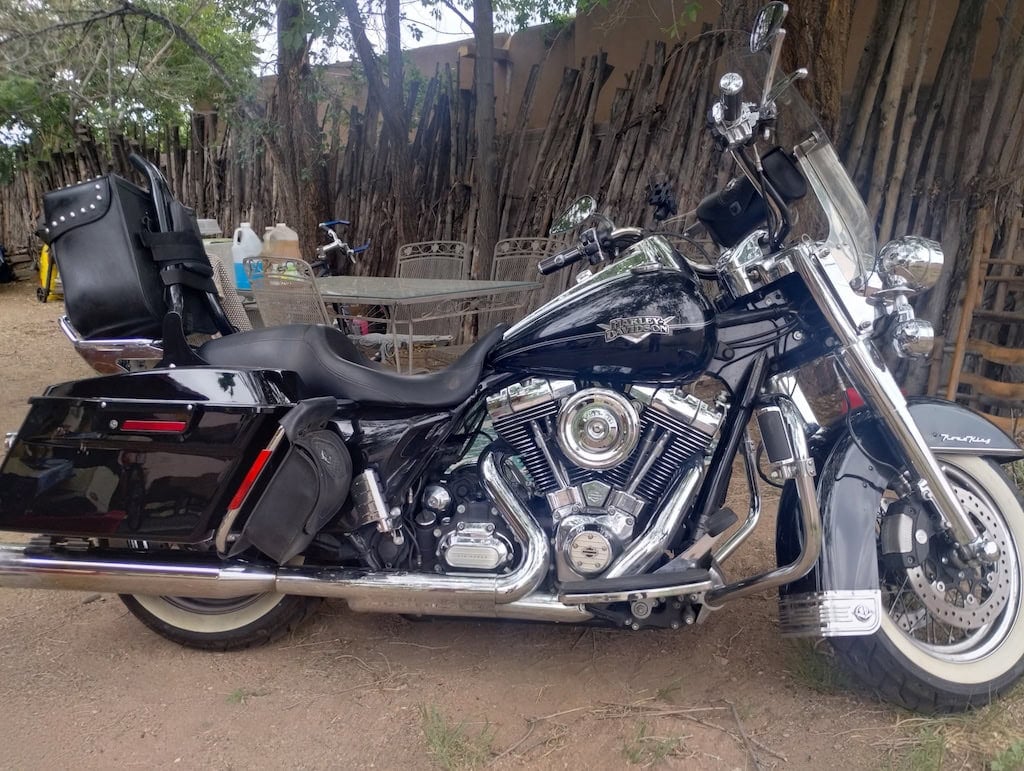
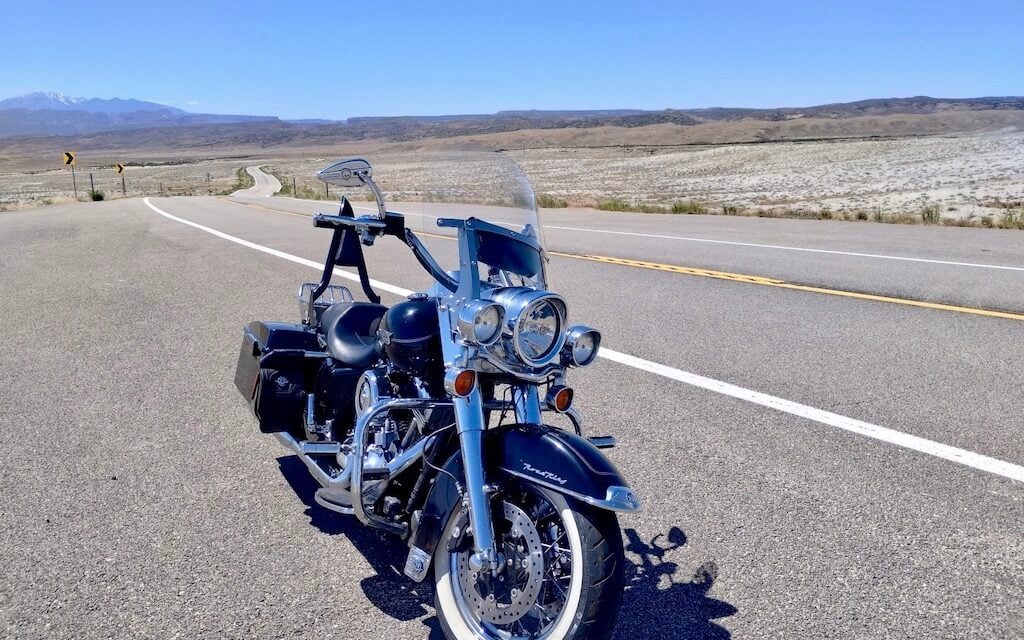
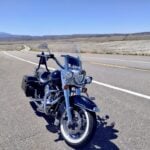
My trusty traveling companion- a 2012 Harley-Davidson Road King.
Pack up the gear once again, head out next morning south down 89 toward Flagstaff, AZ. Then west on I-40 until I could ride no more. Overnight in Kingman, back through Needles, where I learn to always get gas in Needles. Next chance is about 60 miles away. That would have been fine, if there were gas there. A car had taken out the pumps some days before. Next gas was out of the way and another 60 miles, most of it along a zero-services detour to Route 66. This would put me on the outer edge of my fuel reserve. So much for a nice, relaxing ride back.
Signage was a little iffy but I figured the way to the promised oasis, riding through some dirt road patches, praying to the road gods, fighting off 110 degree temps and cloudless sky. Finally, salvation: the desert outpost of Roy’s Motel & Cafe in Amboy, CA. There is neither motel nor cafe at Roy’s Motel & Cafe. That was just a cool, old neon sign. There is however, a gas station. And a snack shop. And on this visit, some 30 mostly German and French bikers on an EagleRider tour. They were on the tour operator’s Route 66 guided ride going I’m not sure next. The fare of the day was mostly anything cold. There was a constant stream of everything Route 66 souvenirs and junk food going out the door.
I was just there for the precious fuel. And precious it was: $8.39/gallon (in June). It cost over $40 to fill the Harley tank. I just had to laugh. It didn’t seem all that long ago that was good for a week’s worth of fuel in my old car. But I couldn’t be happier. Refilled and refreshed, back out into the punishing heat, I was going home.
It was good to be back. Three days later I was ready to hit the road again. Next stop, somewhere out there.
Joshua Placa
Editor’s Note: Road Dirt always welcomes ideas for the next great expedition. Please drop your suggestions in the comment box below.












0 Comments