


The Myth and Mayhem of the West: A Desert Odyssey, Part I
The West is still wild, vibrant and alive in its red rock wonderlands, ancient canyons, burning desert rivers, towering buttes and mesas still home to some native tribes. It resides in otherworldly forms born of water and wind, incomprehensible time and earthly forces beyond reckoning. It lives forever in our imaginations as part myth, part history, all adventure. Riding into the great deserts, dusty towns and alien landscapes is not just piling miles and eating sand, it’s riding into the history and folklore of what once was, and what we still want to be.
Our ideas and images of the West have been shaped by Hollywood and pulp fiction, largely set in the 1860s through 1880s, sprawling western films and dime novels spawning heroes and villains wrapped in nostalgia and inspiring scores of TV shows. Adventurous tales of derring-do and woe, rugged individualism, blind optimism, relentless drive, cowboys and Indians, good guys and gunslingers, untethered freedom and the boundless open range are woven deeply into the American psyche whether true, pure fantasy or romanticized propaganda. Life was a daily challenge to survive. It was dirty, hard, lonely, merciless, lawless. There were and still are things out there that want to kill you.
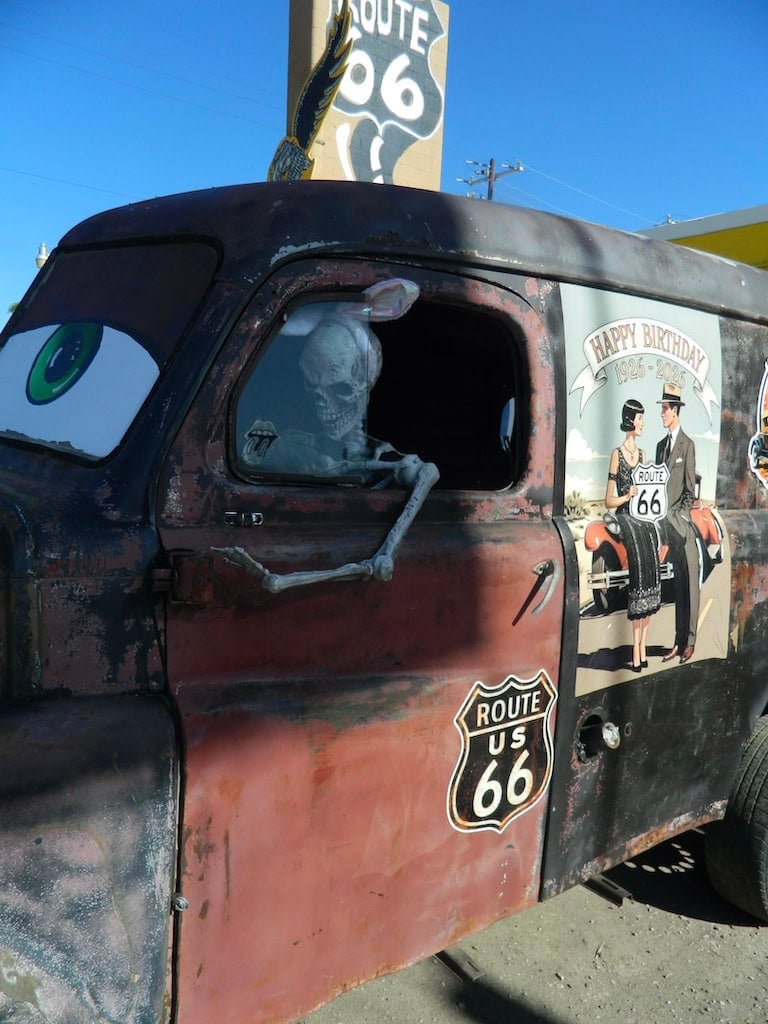
California or Bust: Some people are still trying to get to the West Coast along Route 66.
Useless to Resist
The search for the real West continues with every ride, bringing us back not only to this spiritual place, but to another time and the origin story of our culture. This ride began in what was not so very long ago the small Spanish farming outpost of El Pueblo de Nuestra Señora la Reina de los Ángeles. Now more commonly known simply as LA, or if you want to be cute, El A. This odyssey would take me some 3,300 miles through California, Arizona, New Mexico, Colorado and Utah, crisscrossing a bit back and forth. Drop it into first gear, throw a fist in the air, let out a whoop, and there I was, on the road again, again. This was my siren call. It’s useless to resist.
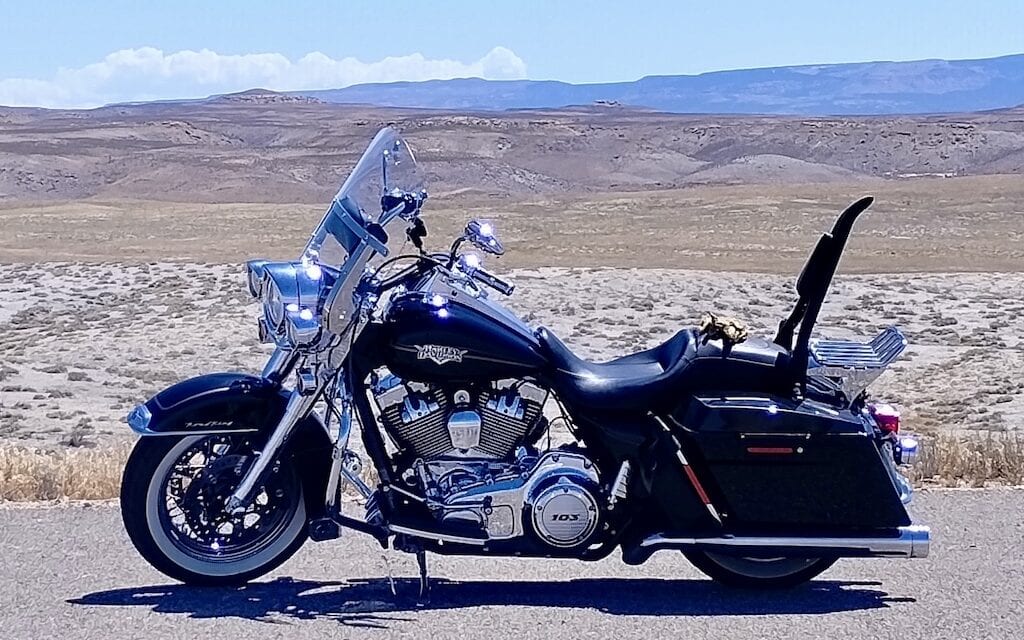
My ride was a 2012 Road King Classic, which I picked up last fall for just such get up and go adventures. My old long-haul bike, the Victory Vampire, a smooth and powerful chopper based on a 2005 8-Ball, was great as long as I was pointed straight, but at its wicked heart was still very much a bar hopper. I’ve written stories about old guys who tired of their chops and butt and back-breaking customs and set them aside for some comfy tourer. Now I became one. No shame, but a kind of road wisdom in knowing I’m not as tough as I once was, or maybe just a little bit smarter and more practical. At least that’s what I told myself.
I still prefer minimalism, so no fairing and cluster of screens and gadgets and switches I can’t figure. Admittedly, I enjoyed the windshield, hard bags and all-day saddle. Of course, the Road King handled better than the chop, but still was a bother at slow, tight turns and parking lot maneuvers. It’s a big, heavy, grumpy beast but wants to run all day and its 103 cubic-inch (1688 cc) Twin Cam feeding power into a 6-speed tranny easily obliged.
I overnighted in Needles, CA, a town best described as a gas stop, then over to Kingman, AZ for a look-around. The town was once and perhaps still known as the militia capital of the our nation, or maybe any nation. Kingman has changed for the better since my last visit years ago. It now has a downtown area with trendy restaurants, shops and thrift stores, which to most citizens is an upgrade. Live weekend music can be heard off Beale Street coming from a couple of different joints. Visit the old Sportsman Club on Historic Route 66 for more of a throwback saloon.
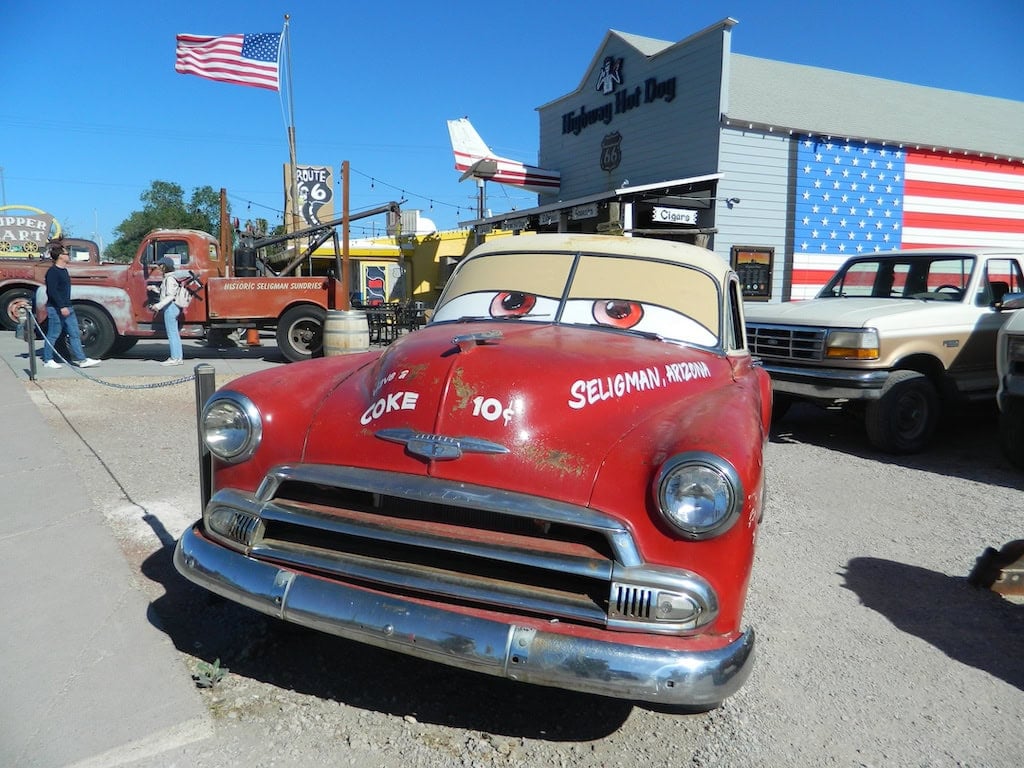
Route 66 continues right through Seligman, AZ, a town dedicated to all things Mother Road.
The Grandma Road
I rode out on the Mother Road which turned 100 this year, making it, I suppose, more of the Grandma Road. Either way, the backroad from Kingman to Seligman cuts through the desert with I-40 running parallel. There’s nothing left of the roadside attractions that may have existed on this 87-mile stretch, albeit the Hackberry General Store, which is mostly a cool looking gift shop, retro gas station (with no gas) and a bunch of rusting vintage cars and trucks laying about, which was enough to make me want to stay awhile and dream of restored jalopies.
Seligman is a town dedicated to all things Route 66. It’s a world of kitsch. The entire town is one souvenir shop after another, spaced by a few restaurants and at least one that is home to a collection of vintage vehicles (Delgadillo’s Snow Cap); another has a whole room of motorcycles and more in the backyard, although I don’t believe any were for sale. The Motorporium/Copper Cart‘s owner/resident wrench is a friendly sort and happy to talk bikes. In Seligman, as well as pretty much every other Route 66 store, there are T-shirts, hoodies, books, and assorted tchotchkes galore, souvenir knives, and low and high-priced jewelry. It’s all pretty much the same from shop to shop.
Back on I-40 and some 43 miles east, the turnoff to Williams takes you right back onto Route 66. It’s lined with the usual memorabilia shops plus a few restaurants and one or two pricey western apparel and jewelry stores, as well as the colorful Grand Canyon Hotel, which was built in 1891 and renovated in 2023. The property possesses a charming elegance, and according to local lore, remains home to a few guests, long past living. Ghost tours are available, and encouraged. The town feels a little more authentic than Seligman but is unmistakably a tourist destination, although nearby residences on side streets give it some hometown feel. The Grand Canyon Railroad, a scenic train to the national park, departs from downtown.
Out of Williams, east to Flagstaff, then south on 89A down stunning Oak Creek Canyon and into the New Age mecca of Sedona. USA Today once described it as the most beautiful town in America. Set among red rock spires that stand as sentinels over views that leave you breathless, Sedona was once a mini-Hollywood, the ideal setting for many westerns, TV commercials and more contemporary movies before it grew too developed and populated to shoot around.
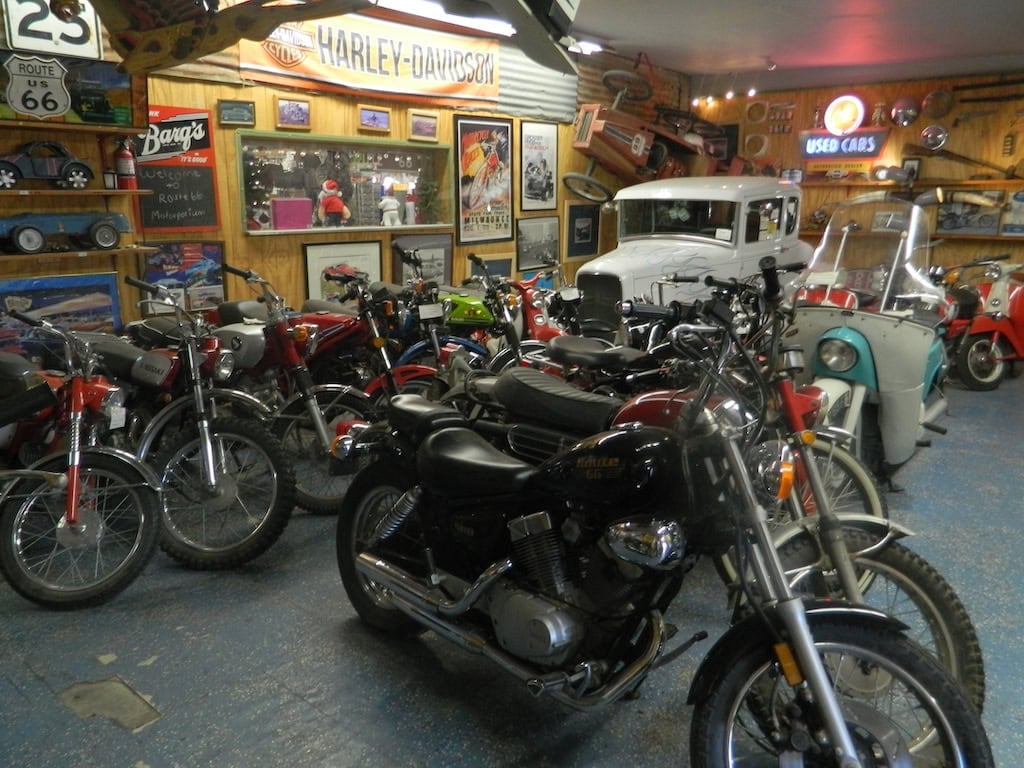
An oasis of bikes and hotrods at The Motorporium/Copper Cart.
Portal to Another Dimension
Sedona hosts some 3 million tourists per year. It is also home to retirees, transplants, New Agers, cults and all the fake healers, shamans, tarot card readers and psychics who prey on them and gullible tourists. It’s known for its five “energy” vortexes, which have been described as portals to other dimensions or sacred spiritual places. Having lived there for 20 years I can tell you it’s all made-up nonsense. It’s a collective invention of the New Age migration to Sedona in the 1980s. If you want to get in touch with your inner dolphin for $1,000, pay for a spirit tour by a “shaman” who makes it up as he goes, buy “healing” rocks or secure a spot at Bell Rock for a fee while someone somehow sold you on the idea it is a cloaked Mother Ship that will soon emerge to take ticket holders on the next flight to Alpha Centauri, then go ahead and enjoy the fluffy feeling of lighter pockets. These flimflams have really happened, and bizarrely, many people have fallen for them, and continue to get suckered.
Go to Sedona for its stirring beauty, its wonderful hiking, mountain biking, canyon camping, nearby native ruins and nearly ideal year-round climate. Cool off in its waters, hike West Fork. It’s an expensive destination and the cops will pull you over for just about anything and everything (do not speed, even a little bit; do not roll stop signs; do not jaywalk), but if you budget for the high cost of accommodations and dining, spa treatments, Jeep tours or horseback riding and think of the rest as amusements and not reality, then by all means indulge.

Canyon de Chelly National Monument, a mythic, beautiful place.
Remembering Navajo Route 15
It was great to visit old friends, including one knucklehead I just ran into at an old haunt in the nearby ghosty town of Jerome, but a few days of Sedona weirdness and traffic was all I could stand. I rode up to the Navajo Rez, rediscovering Route 15, which I picked up at around Leupp, AZ. I remember 15 as a lonely road marked by scores of cinder cones, lava domes and basalt fields scattered around the landscape, remnants of the 600 or so hopefully extinct volcanoes in northern Arizona. The once largely empty landscape had added schools, housing and markets, including at least one major grocer and, closer to Window Rock a, yuk, Burger King. Good news, of course, for the Navajo community, but what was once there wasn’t there anymore.
Just a bit north near the town of Chinle is the little known Canyon de Chelly (de shay). It is spectacular. Sheer, red sandstone cliffs drop 900 feet into a canyon once home at different times to the Ancestral Puebloans, Hopi and Navajo. Ride to all the overlooks, hike down the White House Trail to see its ruins, take a Jeep tour. The national monument is free to enter and park. There aren’t a lot of guard rails or warnings. The Navajo seem to think only white men are stupid enough to walk off a cliff unless there is a sign telling them not to. There also aren’t a lot of goods and services in the area, which I feel adds to its appeal. Owned and operated by the Navajo, I suggest staying at the Thunderbird Lodge, which is right inside the park.
Route 15 turned into rough asphalt for some 40 or 50 miles before reaching Ganado. The long, jolting ride loosened or knocked out my ABS sensor. The brakes worked fine, but the warning light remained on for the rest of the trip, fixed neatly by a nice piece of black tape. I suppose I should get to that.
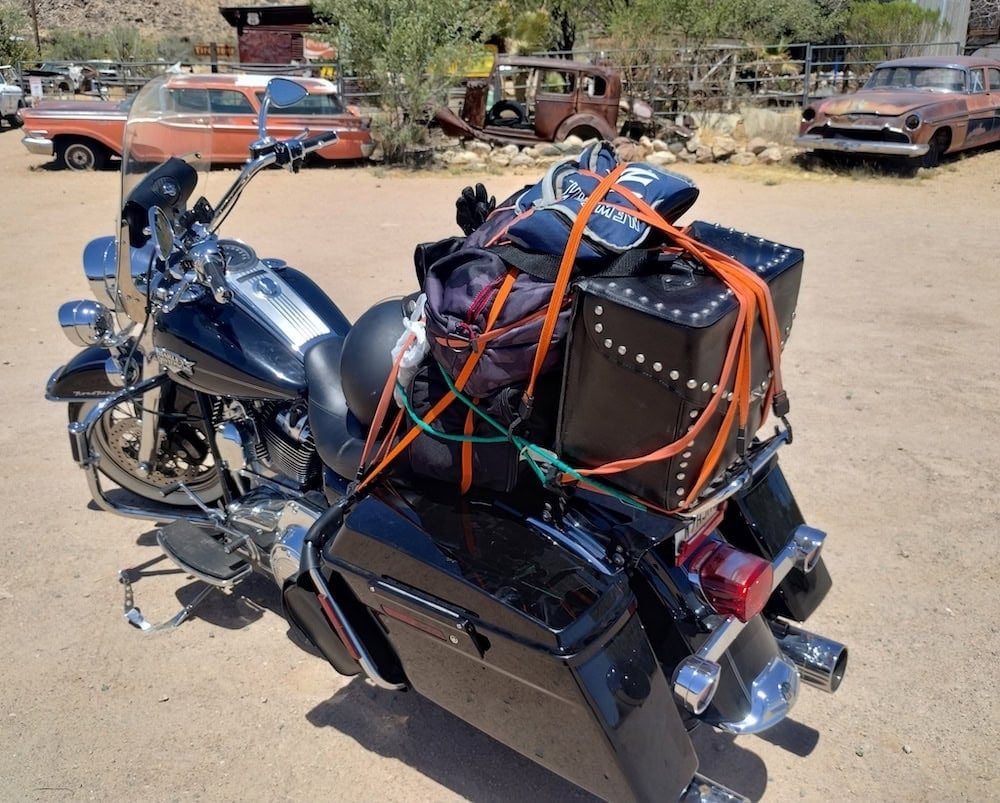
In the endless gift shop parking lots out West, rusty jalopies stand as steel epitaph to old Route 66.
The 152-Year-Old Trading Post
Along the way, I stopped by The Hubbell Trading Post, a national historic site. Built in 1874, the landmark is the oldest continually operating trading post in the US. The store is divided in two. An old wooden door opens to a dry goods, souvenir and general store-type grocery section; to the right is a couple of rooms of handmade Navajo rugs and silver and turquoise jewelry. Beautiful stuff, but prices for these items run into the many thousands of dollars, like around $15,000 for a large or vintage rug or $7,000 for a bejeweled silver cuff. Tempted in a crazy, I can buy whatever I want because road trip dollars don’t count, I did think the rug would look quite good rolled up like a bedroll on the bike. Sanity, for once prevailed. I bought an apple.
Good thing I also bought a souvenir for my daughter at the post. As I opened my hard saddlebag I saw it was hanging on by only one of the two pins that secure it to the fender strut. Losing it on the road, with all its vital contents, would have left me in a seriously poopy mood. After some fidgeting, I was able to secure the petulant pin and continue on. A bit of drama there, but the bag was no bother thereafter.
Turning south on New Mexico Route 491, I tucked in for the night in Gallup, noted for its Navajo and Zuni trading posts or what really amounts to jewelry stores. You can find some exquisite things here, but bring your credit cards, all of them. The prices have skyrocketed some 400% to 1000% or more over the last couple of decades. In the early aughts, silver ranged from $5 to $10 an ounce. It reached $120 per troy ounce before settling into the current for now $80 to $100 per ounce range. Semi-precious gemstones have also risen dramatically.
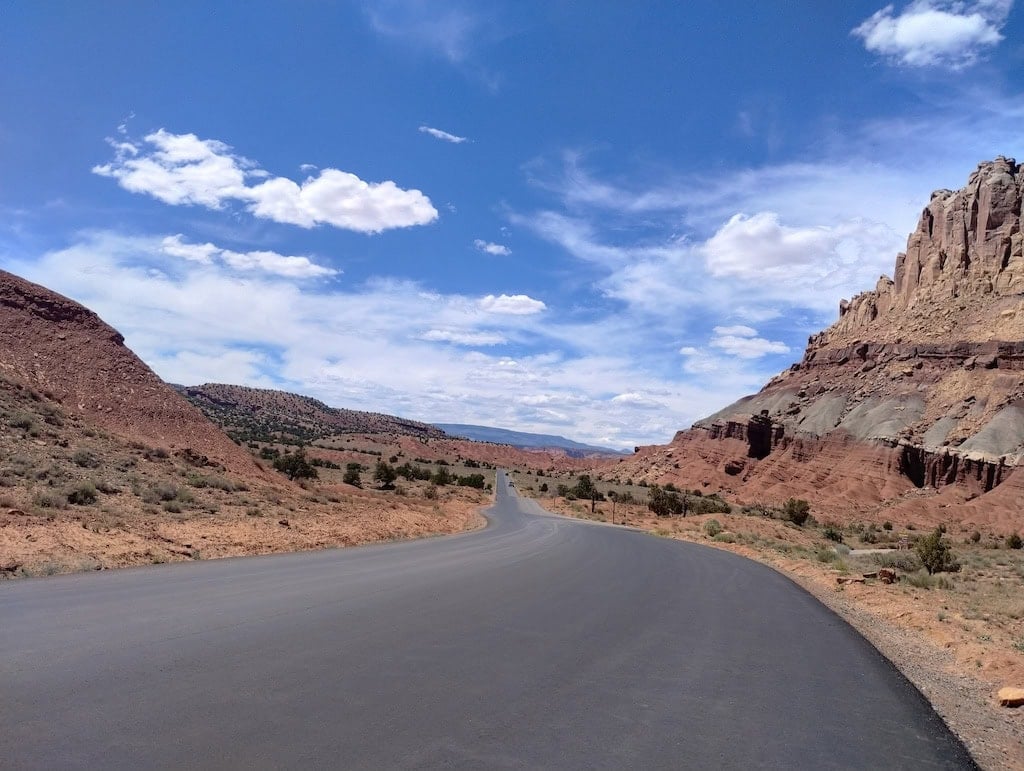
The road goes ever on. And we must follow.
John Wayne Slept Here
The jewel of Gallup is the El Rancho Hotel, its dramatic lobby welcoming you with authentic Old West photos, artwork and memorabilia. The hotel is a piece of celluloid history. Facing Route 66, the property was once the home away from home for Hollywood Golden Age movie stars. Rather than numbers, all 75 rooms are named in their honor. As I’ve passed through in prior years, I made a point of stopping at their restaurant, where a fine meal was always offered. I stayed some years ago in the John Wayne room, if memory serves and it sometimes doesn’t. Might have been the Roy Rogers suite. Anyway, prices, of course, have risen significantly since then, especially since the rooms were recently refurbished. If you’ve never been and don’t mind splurging a little, stay a night or two. I had a bowl of the pork and green chili stew, which was excellent. Then left for my fleabag motel back down the wrong side of Route 66.
Next morning found me rolling on I-40 east, heading toward Albuquerque, then north up I-25 to Santa Fe. It was time to see missed friends and take a needed rest from the road.
J. Joshua Placa
*Western Odyssey is a multipart series. See Part II in an upcoming digital issue of Road Dirt and across our platforms.

















As good a road trip story as any I’ve ever read. Plus I’ve been on much the same route; the memories are still vivid.
Thank you, masked man.