

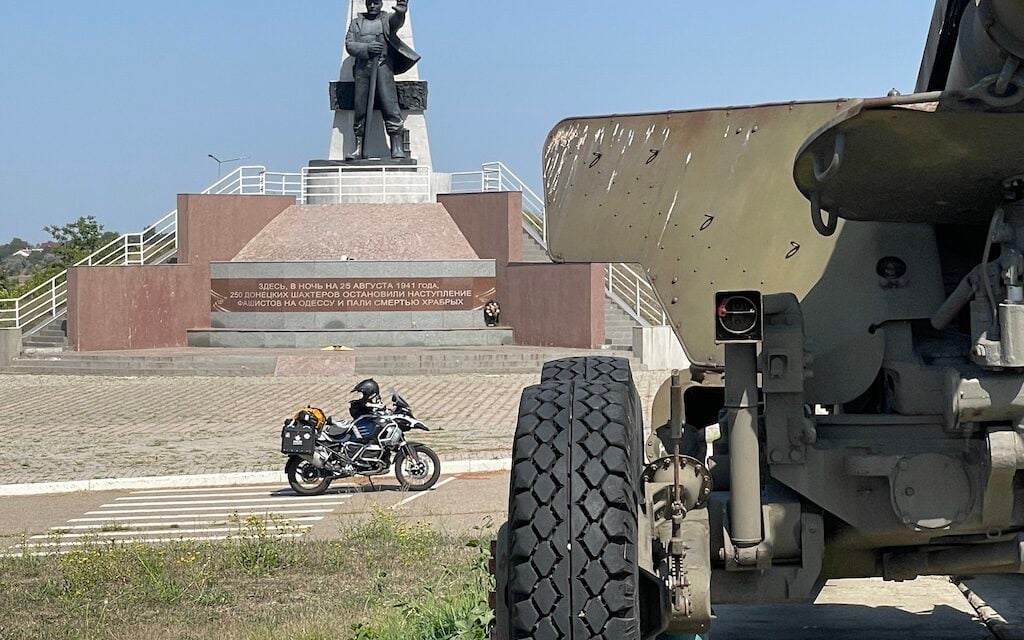

The story of Nazar, a truly inspiring human being
Editor’s note: In Neale Bayly’s first installment of this summer series, “Solo Moto“, he recounted the overall scope of his life-changing 5-week motorcycle trip around Ukraine in 2023. That trip changed his life in profound ways, and sent Neale off in new directions with his Wellspring International Outreach foundation. Now he will introduce one of the amazing people he met while riding through the war-torn country, in this part 2 of the series.
“I’m going to walk into the center of town for coffee and a smoke with my friends, then my girlfriend is going to have sex with a Superhuman.” I can’t help but laugh, Nazar laughs, and in this special moment I’m lifted by his incredible happiness. He is going home a hero, and for the first time since a Russian artillery shell took his leg and after undergoing 17 surgeries, he will be without his wheelchair.
Nazar Dzunbar was born in the city of Kalysh in November 1997 near Ivana Franko in the foothills of the Carpathian Mountains. His mother and father separated when he was young, but his childhood memories are good, recalling fishing with his father and his mother’s new marriage in a positive light. He went to college at Lviv State and studied engineering before going to work as a gas and petrol engineer. During this time, he lived at home in his family’s apartment, and started a relationship with his girlfriend Diana who has a three-year-old son. He had dreams of seeing the USA, and potentially working there, especially Kentucky and Texas due to a keen interest in the whiskey from these states.
And then February 24th happened. Waking at 5.a.m to the sound of explosions, he initially stayed with his parents to make sure they had food, water and all their documents on hand. There was wide-spread panic in his city as the banks ran out of money, grocery stores of food, and the petrol stations were quickly out of fuel. Watching the horror of the invasion on the news, he thought, “I must go and fight.” People were suffering and Nazar knew the story of Holdomor. He knew he was born in a free Ukraine and always heard from his grandfather, “Russians are our enemy and will f**k us at every opportunity.” He told me those first days felt like a nightmare: the explosions, the dead bodies, and how his mother cried when he told her, “I go to war.” He bought boots and supplies before signing up to join the 10th Brigade. He was given just three days of mostly firearms training, but thankfully had previous military experience so was at least somewhat prepared. “I felt scared but knew the enemy must die.”
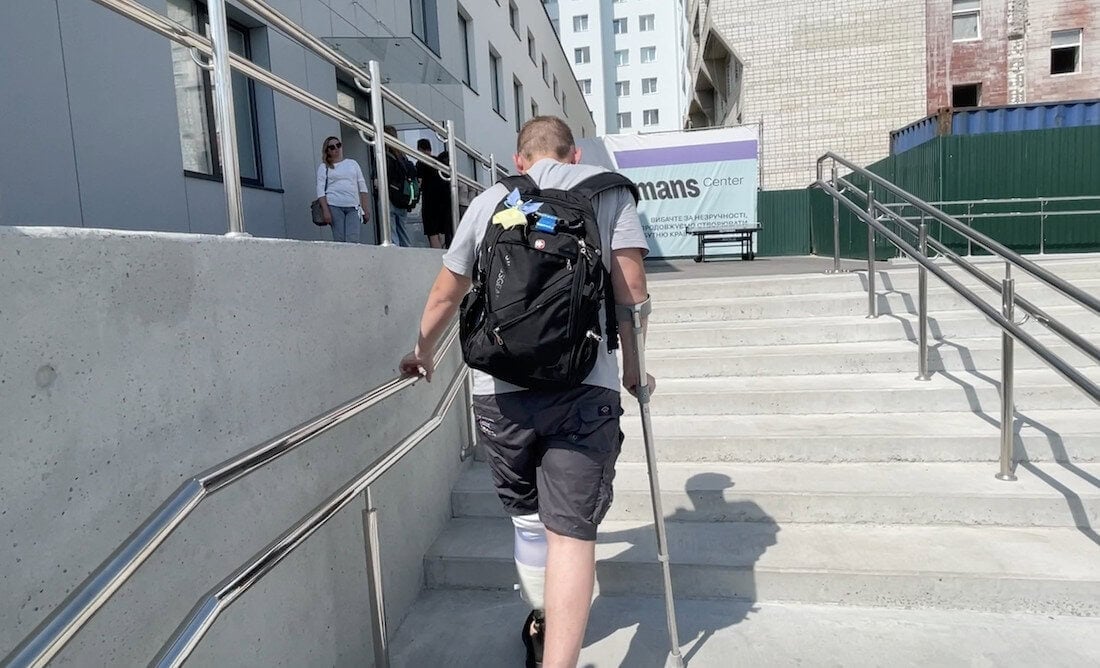
Nazar coming to the Superhumans Center in Lviv, Ukraine, for various physical therapy sessions.
Our conversation is interrupted when Nazar has to go for a hygiene massage appointment. We are at the Superhumans Center in Lviv, a modern rehabilitation facility for adults and children who have been injured on the battlefield or the street. Watching Nazar pull himself into his wheelchair, I ask if I can come with him to which he instantly agrees. The therapist greets him by name and he hops up on the bed for her to clean his scar. Nazar has a low amputation of his left leg below his knee, and it’s very important for the wound to have a strong massage to remain soft and malleable. Nazar then lays back looking like he’s at a luxury spa, and is light and funny as he makes jokes. If there is any pain involved with the process, he’s not letting on. The therapist tells me it’s very difficult for some patients, so she has no idea if Nazar is putting on a brave face or not as he never complains. In short order we depart for lunch, chatting about all sorts of things, before resuming our positions back in the coffee area.
At certain times during our chats, I see Nazar struggle. He is incredibly articulate for someone using my language and his insights are clear. I don’t want him to get tired, so suggest I go with him back to the accommodation where he stays while in rehabilitation at Superhumans. We can pick up our interview tomorrow. He likes the idea and jumping in his wheelchair, I assume position as driver. He is tired after treatment and we take off together deep in conversation, but not about the war. There is a coffee shop where we can get a drink and hang for a while before he finally needs to rest.
The following day we pick it up in the coffee area and, while I’m looking for a chronological series of events to document his story, memories come at random moments with varying intensity and in no particular order. After training, his brigade went to Kyiv where he spent two weeks learning to launch Stinger missiles. “We had to act quickly. We had to defend.” Hurriedly being moved up to the front line, he worked one or two kilometers behind the infantry studying the Russian planes and figuring out how to shoot them down. Another random memory comes in and I scramble to keep up with my note taking. We are suddenly on a roof top with women and children being evacuated below when a plane attacks and drops a bomb fifty yards away. “I was scared shitless, but thankfully the bomb landed in the forest and three or four buses were able to get away safely with everyone being evacuated.”
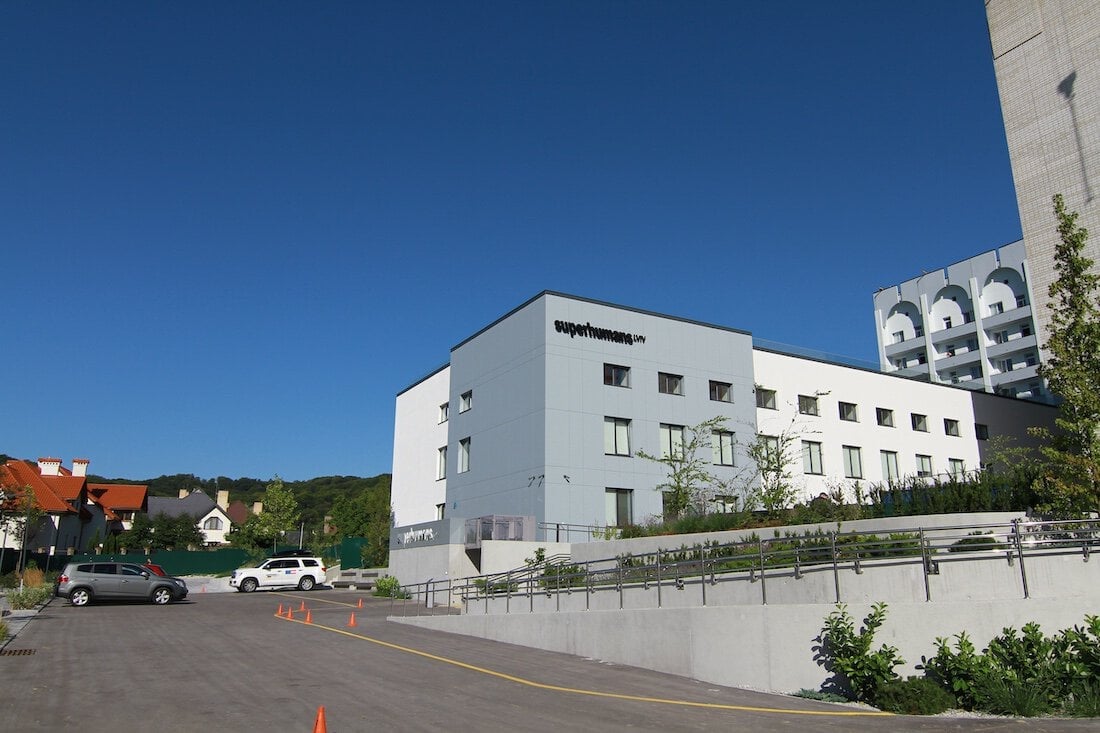
The Superhumans Center in Lviv, Ukraine.
Nazar was soon moved forward to be with the infantry. “It was hell.” At this point they were pushing the Russians back, but then he jumps to defending now, and firing a rocket launcher at a helicopter, missing, and watching another guy take it out. “We lost two men that day,” he tells me, but I have no idea where it fits in the story. I just keep writing.
“The first time I saw dead bodies I was crying. The smell was terrible and seeing the first body parts made me feel sick.” Sitting with this quietly spoken young man, the recollections of his first experience of death were so clear as he let me into his deepest emotions. “I was scared of the grenades, the noise and then I killed my first Russian. I shot him in the head. Holy Shit. What the F**k. Bullets were flying, there were explosions and it was madness.” His mission was to help the infantry destroy the attacking enemy and along with his AK-47 he was given four magazines, each containing 30 bullets. I asked him how long this would last and he told me around three to four minutes. With his vivid picture of the battle playing in my head, I asked what did he do when he ran out of bullets. “I had to load separate bullets I got from looting dead Russians.” While he vividly describes loading rounds with his hands shaking, he is suddenly back to explosions, bullets, dead bodies and confusion and I’m not sure if it’s the same battle but don’t want to interrupt. A therapy session means we need to take a break, and the way the last memories have made him sweat and shake, I think the timing is good. We adjourn for the day.
“The smell of the dead bodies rotting in the sun was so bad we needed to bury them. They leave their dead, they leave their wounded, they just don’t give a damn.” Nazar is clearly angry this morning, then quickly calm recalling the different smells: gunpowder, artillery, dead bodies. It’s a lens into a world I can’t possibly understand and again his descriptions are so vivid and clear, I’m blown away he is using my language.
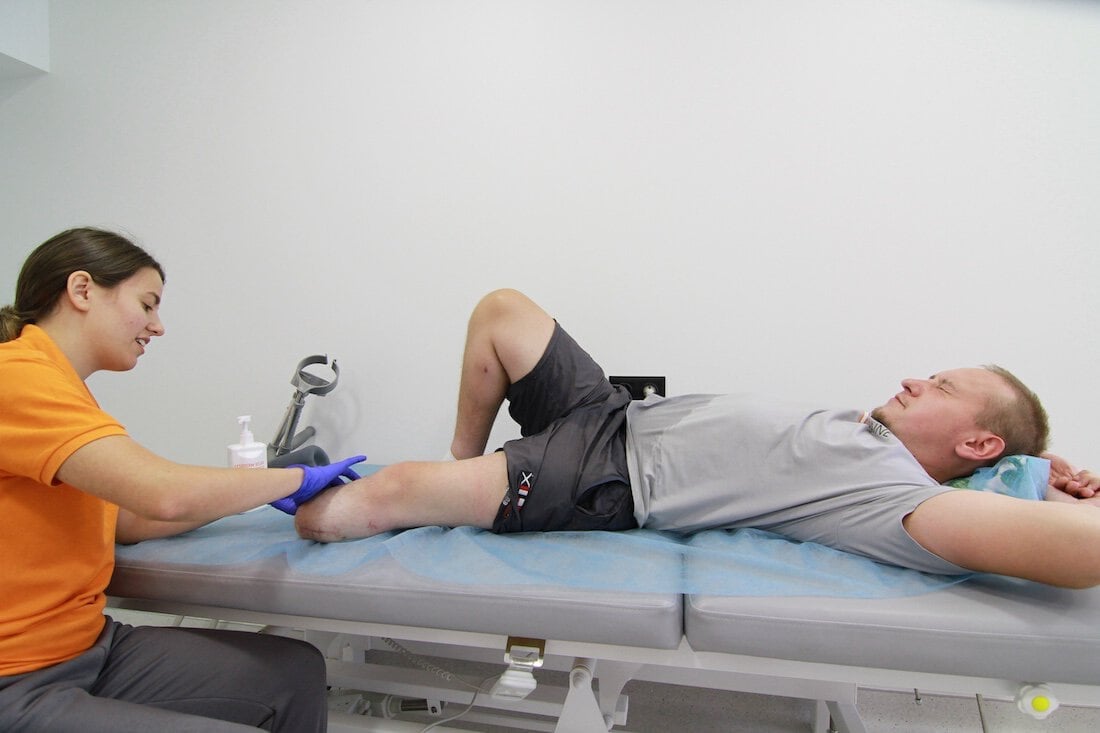
Undergoing a painful physical therapy session at the Superhumans Center.
“For one year I don’t see my family. I can take some pictures, but not of the dead bodies,” he tells me. He was able to have some basic communication with his girlfriend, but only by text. A heart emoji or, “I’m ok.” At one point when the Russians cut the phone and internet, they had no communication for six days which was extremely hard on him, but mostly he was able to send messages.
Then the explosion that took his leg.
He remained conscious during the whole ordeal, applying his tourniquet with calm while hoping he would be evacuated as soon as possible. He even gave his pain medication to a fellow soldier more badly injured than he. This is the critical time for wounded soldiers, and Nazar knew if he didn’t get to hospital quickly he would lose all of his leg. The big problem he faced, indeed all soldiers wounded this way face, is the dirt from the artillery shell explosion that gets in the wound. This causes infections and complications and over the next two months, he would go through 17 surgeries and multiple infections. He sank into deep depression from the surgeries, the medications and the pain. “Everything was white like snow,” he tells me as I see him fighting again internally, recounting his ordeal. I wait for a short while before asking how he came through. “Hope. Faith. Family. I feel I have a purpose in this life. I felt I must live. I must survive.” Like all the young men I’ve spoken to who have been injured in this war, Nazar is in a hurry to get back to the fight, wanting to run air defense when he is fully mobile. This goal will be a big step closer in a couple of days when he receives his permanent prosthetic leg and can finally go home.
“We were all scared, but men must be in the middle of fear and panic. Fearlessness is not good as those guys die quickly.” We are suddenly back in the battle, Nazar recounting his personal fear, the panic and how he fought to overcome it. “The fear never goes away; I struggle but I win.”
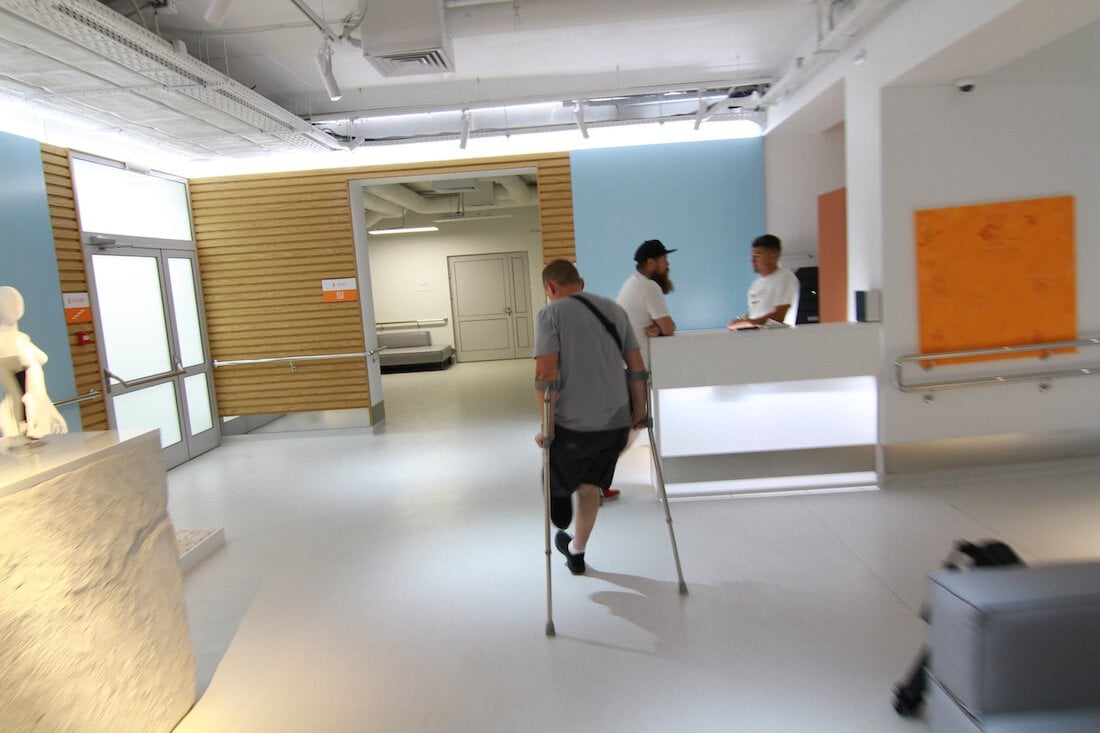
Feeling stronger every day, Nazar is quite literally making incredible strides.
Arriving at Superhumans has been a really positive experience for Nazar. “It gives me hope, it gives me strength that it’s not over. We are not Russians, we have the will to fight for our country, our land. Yes, we were slaves, but we will never forget who we are. We are on fire.” He is very complimentary about the staff, the facility, and lists all the treatments he has on a daily basis: physical therapy, pool treatment, psychology visits, nutrition advice and the hygiene massage treatment I joined him for.
During my ride to Superhumans the following day, I want to know how Nazar coped with the surgeries, the depression and loss of his leg because he is clearly in such a positive place compared to the early days. I don’t find him till later in the day and when I ask him to expand what he has already told me, he answers with just one word, “Boila.” I ask him the meaning and he explains how it’s a special Ukrainian word that means a type of feeling and strength that carried him through his darkest of days. I’m almost speechless, and with Nazar clearly exhausted from his day, we have a coffee and just chill out for a while. Tomorrow, August 17th, is going to be a very special day so I bid him good day and head for my hotel.
On arrival the following morning I can’t find him, but know he’ll show up at some point. There are a group of the guys hanging out under a tented area smoking, so I join my buddy Andriy, the press agent for Superhumans, when I hear Nazar’s voice. “I’m standing on my own.” The excitement in his voice hits me like an electric shock and I look over to see him walking towards me. He has his prosthesis fitted and, while he is using his crutches, for the first time since May 18th he is standing on two feet. I’m fighting back tears of joy as we walk back to the building for a coffee, Nazar talking a mile a minute about how his girlfriend says he’s sexy with his new leg. Then the line about having sex with a Superhuman comes out to my loud outburst of laughter. He is going home a hero. He is going home to see his family for the first time without a wheelchair and I’m with him for this incredible moment.
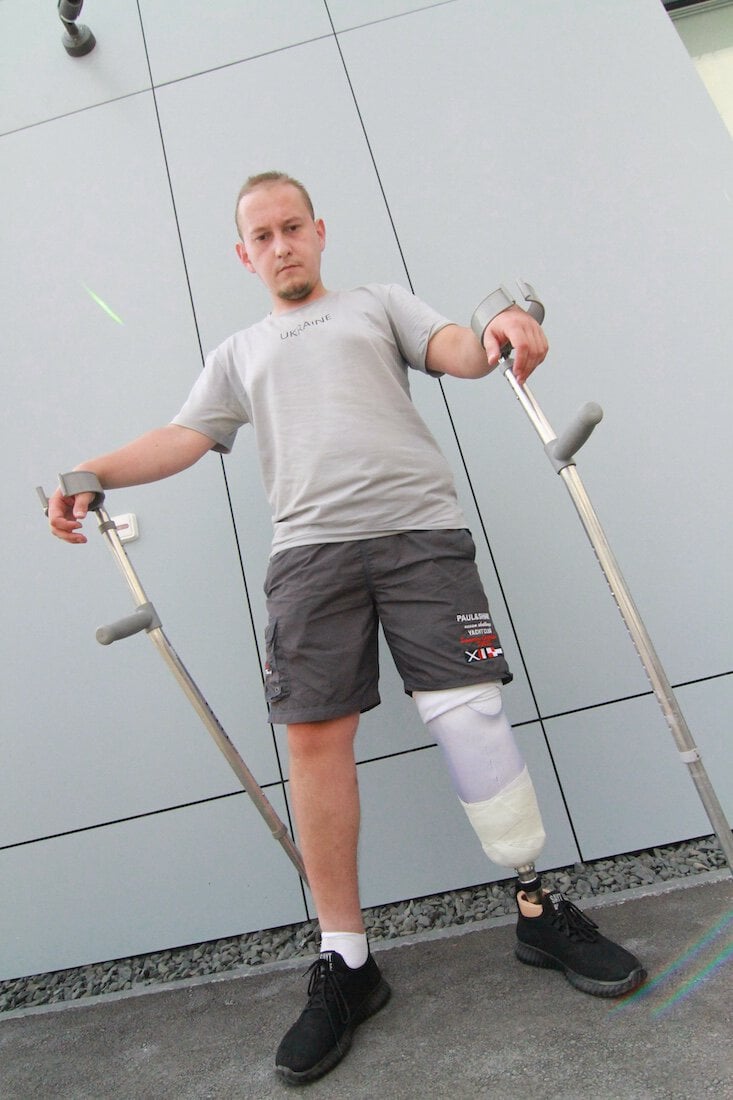
Standing proud and strong.
Nazar will need to return to Superhumans. He has a long road ahead with therapy and prosthesis adjustments, but he is on two feet and on his way. It’s an emotional goodbye as I thank him for the time we’ve spent together, leaving him to prepare for his journey home. Walking back outside to collect my thoughts, I think about this deeply insightful and sensitive young man. An engineer, a boyfriend, a son and now a friend who had dreams of traveling the world before being forced into the hell of war to defend his nation and his people. He is also a warrior, and I have absolutely no doubt he will never stop fighting for his family, his friends and his country. Slava Ukraine.
Neale Bayly


















Wow, WOW, what powerful writing! You brought home the personal story of a blown up survivor of the horrors the Ukrainian people endure while defending their land. Most Americans view this war from outer space, you get down into the soul of Ukrainian people, and all they have to deal with while the rest of us shop at Walmart.
Well-said, Ticia.
Excellent story. I’m sending it to a friend who might donate to Superhumans.
beautiful story, beautiful human being. inspiration for the rest of us regular humans, somehow I wish I could give this man a motorcycle.
Thank you.
Great profile. The workshop-in-a-garage story is more common than people think, half the good builders I know started exactly like that. The hard part is never the wrench work, it is getting anyone to see it. A friend with a similar shop films his builds on a phone and cuts the short promos with Ravvi, and that alone brought him more work than any local ad ever did.
Bookmarking this one — the walkthrough is a lot clearer than most write-ups on the topic.