


A life-changing, five-week motorcycle ride through war-torn Ukraine
Editor’s note: Neale Bayly has ridden motorcycles all over the world, but a trip through beautiful but embattled Ukraine dramatically changed his life a few years ago. He’s wanted to share these stories of triumph, hope, and resilience amidst the horrors of war for some time, and now Neale has honored us with his trust in publishing these accounts. In this introduction to a series of stories, Neale gives us a broad glimpse of his life-changing experience, with more to come in the weeks and months ahead.
What am I doing here? Out in the wide-open farmland between Dnipro City and Kharkiv, as I realize I haven’t seen a house, a car or a person for what feels like too long, the voices are winning. The voices that, on the surface at least, are gnawing at my psyche as they repeatedly question my purpose in Ukraine. The more rational part of my brain argues it is just stress and fear finding a way out, as my ego won’t admit to being afraid. That the constant air alerts, blown up buildings, and at times explosions on the horizon are not bothering me. I had come face to face with my fear the previous year I thought so surely, I was beyond that now?
Then it happened! Out of nowhere a gas station came into view on the outskirts of a small town and I pulled in to refuel and drink a coffee. A chance stop that created a chain of events that would allow me to make sense of this five-week, 3,000-mile solo motorcycle ride around Ukraine, while also affording me the opportunity to silence the voices in my head as I was finally shown my purpose for being here.
The beginning of this two-wheeled journey had started some weeks earlier in Munich, Germany, on an unseasonably cold day. I had flown in from my hometown of Charlotte, North Carolina with my friend Erik Minmen, and taxied over to the BMW Motorrad press fleet building where a BMW R1250GS Adventure and a F850GS Adventure were waiting. A quick coffee with Edgar Heinricke, head designer at Motorrad at that time, and a challenging thirty minutes finding the best way to attach our gear, we hit the road.
A good push saw us lose the cooler German weather and roll into Czech Republic bound for Prague. We found a nice hotel and cruised the picturesque city on the BMWs, taking in the sights in the warm summer air. The city dug deep into my memory banks as I remembered my first visit in the saddle of a motorbike back in 1996. The following morning, we elected to ride to Krakow in Poland, and with it not being a great distance I set the GPS to “avoid highways” as we spent a leisurely day exploring the pleasant Polish countryside. Our evening was spent wandering and dining in the main square. Founded in the 13th century, it features the famous Cloth Hall, with tower, church and monuments set around it. Warm evening air, street music drifting across the square and the sound of children at play should have been a delight. Knowing we would cross the border tomorrow into another world, a world at war, seemed to cast a shadow over everything though, so it was a quiet evening.
A world at war
Closing in on the Ukrainian border, the modern highway snaking through the lush Polish farmland should have been filled with cars, but we found ourselves alone. Thankfully on arrival, the lines at the border were mercifully short, and we used our motorcycle privilege and bypassed what lines there were. The exit and entry process were a bit stressful with one Ukrainian border guard not willing to accept the paperwork that came on the motorcycles. We waited as they spoke at us in a language we couldn’t understand before slamming the mirrored windows shut. Play dumb. Look around. Re-adjust and tighten luggage for a third time. Try not to look as if we are in a hurry. Finally, the approval came, then another window, more questions and more waiting before our passports and papers came back with a smile. In reality it wasn’t a long process, it’s just a long way to come to contemplate having to turn around and head for home.
The ride into the city of Lviv in western Ukraine is known to me now, and where everything was a surprise on the first trip, today it all seems familiar. Lviv is bustling as we arrive in glorious sunshine, and right on cue as we pull up to our hotel the air alerts scream out across the city. For me I understand it probably means fighter planes in the air somewhere in Ukraine, but I’m sure it wasn’t what Erik was hoping for on arrival.
Our next couple of days were spent in Lviv with friends. We visited an apartment complex digging out of a recent missile strike and spent a day at the Superhumans Center. This is a state-of-the-art rehabilitation facility set up to deal with the injuries of war, principally amputations.
Too soon it was time for Erik to saddle up and head for home. I would be traveling alone from here on so after escorting him to the border and saying goodbye I rolled back into Lviv. The first ride alone, I seemed more attentive to the houses, shops and churches in the small towns I passed without another rider to focus on.
Back in the city I settled back in at the Loft 7 Hotel and hatched a plan to spend my week visiting the Superhumans Center. While we were visiting, I met a young soldier who had been the focus of a news story in one of the big mainstream publications in America. Featuring dramatic photography of him with his prosthetic lower limb it seemed most of the articles I was seeing coming out of Superhumans were in this vein. With an idea to try a different approach I ended up sitting with a very articulate young man called Nazar for a coffee. Over the course of the week, we entered into a number of long, and intimate, conversations about his life and experiences during the war, and a lot of intimate details about his injury and subsequent amputation.
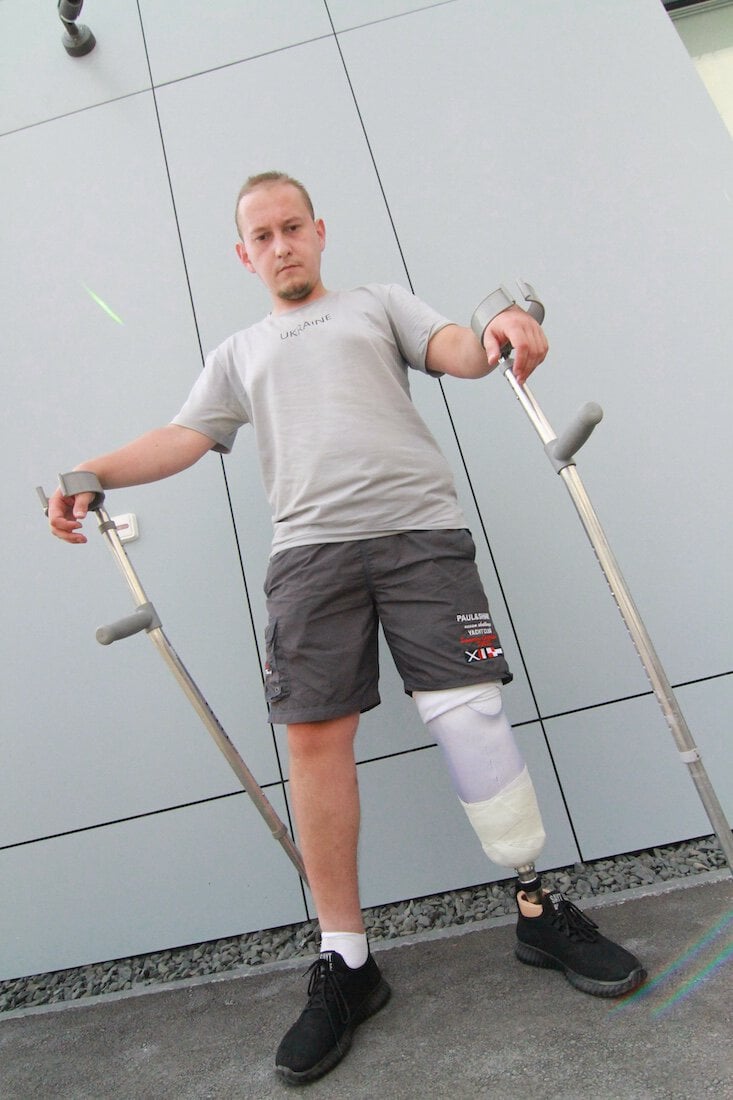
Nazar at the Superhumans Center in Lviv.
The week flew by: Meeting with my friend Andriy Iscyhk, the press officer, in the mornings and giving him a ride to Superhumans on the GS, riding through the vibrant city streets, dodging trams, buses, cars, people and bicycles while navigating ancient cobblestone streets certainly fit into the adventure category. Watching the daily events at Superhumans, interacting with soldiers, staff and other journalists meant the days were intense, at times emotionally overwhelming, but thankfully always defaulting back to laughter, joy and hope. The spirit of these Ukrainian warriors adapting to life without limbs is one of the most powerful experiences I have yet to have on this big, round ball we call Earth.
Too soon it was time to say goodbye and ride east. An online motorcycle connection had produced an offer of a place to stay with a couple, Igor and Anna, just outside of Kyiv. There had been a few hiccups during the week when one of my cameras failed, which necessitated renting another body, and all the usual lack of sleep from air alerts but thankfully nothing major.
With the main highway out of Lviv blocked for an accident, my first miles out of the city took me through peaceful villages and lush farmland as the GPS routed me through the country. The sun was shining, the air was clear and with barely a cloud in the sky it could not have been a more perfect day for a ride. The big GS handled my camera gear, clothing, body armor and combat lifesaver bag with ease as we spun through the gentle rural life being played out across my handlebars. Out here there is no destruction and it’s easy to be lulled into forgetting there is a war on for a time.
There is a war on.
I pulled up to a road junction though, and the remains of a military block post with rusted Czech hedgehogs littering the side of the road brought the war back front and center. I picked up the E40 and it soon turned to four lanes as I dialed the big GS in around 75 mph. There were a few small towns as we headed east and after a couple of hours I was navigating around the town of Rivne. Not quite halfway to Kyiv I pushed on and once I’d cleared town, I was back in the thick of farm country with endless fields disappearing over the horizon on both sides. Sunflower fields are everywhere here and with corn, wheat and barley being the other major crops it’s no surprise to learn that 55% of Ukraine is given over to agriculture.
Riding in Ukraine is so unique. Pull up behind a large truck or similar, and they will move as far right as they can, and when it’s safe to pass they will flash their turn signal to help you. See a car approaching quickly in your mirrors, pull to the right to help him make the pass and they will give you a couple of flashes on the hazard lights. Stop at a gas station anywhere in the country and it will be exactly the same. Spotlessly clean, serving great coffee with free WIFI and staffed by the most well dressed, polite service station workers you will find anywhere in the world.
About a hundred miles out of Kyiv I was more than ready to arrive. The four-lane highway seemed to be endless and the heat was getting to me with it now approaching triple digits. Finally, the outer ring of Kyiv appeared and I was amazed to see how much of the destruction I’d seen just one year ago had been cleaned up and rebuilt. There are still some brutal reminders in the twisted, charred remains of a large industrial building and a few smaller buildings to the side of the road but not much.
Following the GPS coordinates I was soon off the main highway and picking my way through smaller neighborhoods and on to a forested area, crossing lakes and villages no bigger than a few houses at the crossroad. With the roads growing smaller I finally found Igor and Anna Trubenok (their story here) and we pulled the big GS into the gated garden for the night.
Over the next week or so I was treated to some wonderful Ukrainian hospitality, and a chance to settle in to a small village to experience life as it was being lived in war time.
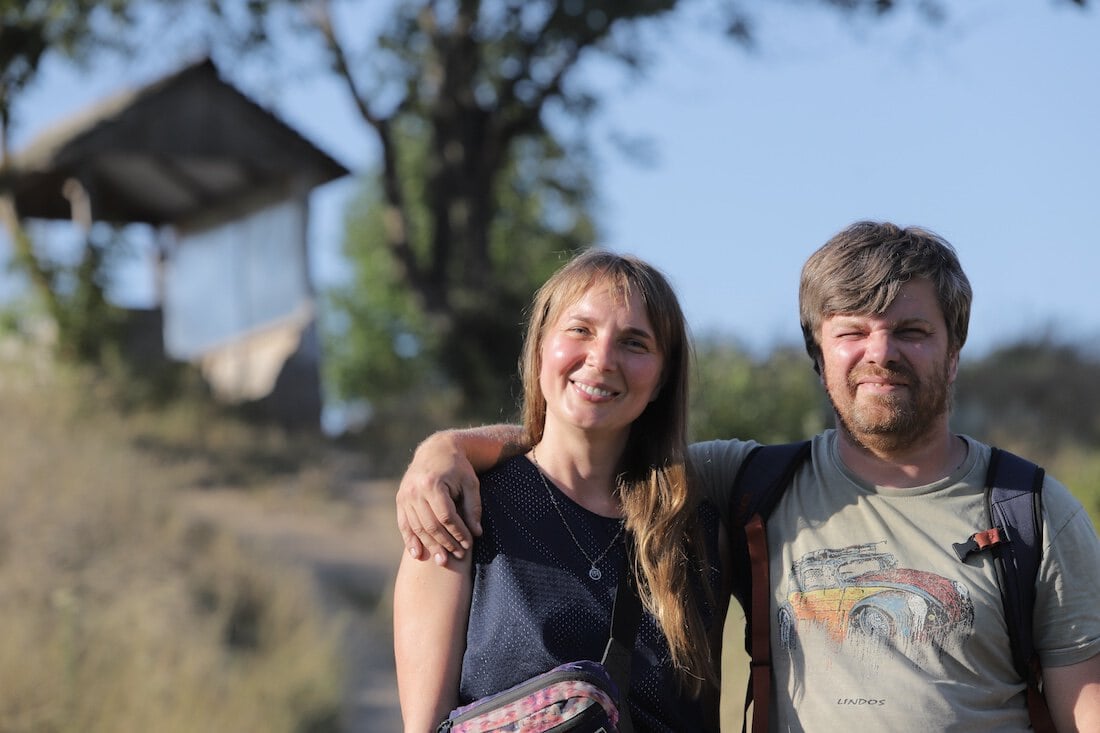
Igor and Anna. Such a precious couple.
During my time at their home, I had a couple of meetings in Kyiv, so would slip out on the GS to attend them. One was with round-the-world motorcycle traveler, now soldier, Anna Greschiskina. We had met the previous year, and I had written a magazine feature about her for Rider Magazine so it was a warm reconnection over coffee. The other was with a pastor named Sergey Lysak in Hostomel. I happened to arrive as he was addressing his congregation in the new church he built since the war started to better serve his community. I went inside to listen and I’m not sure I’ve ever heard a more powerful, or moving, message. It took my knees out from under me.
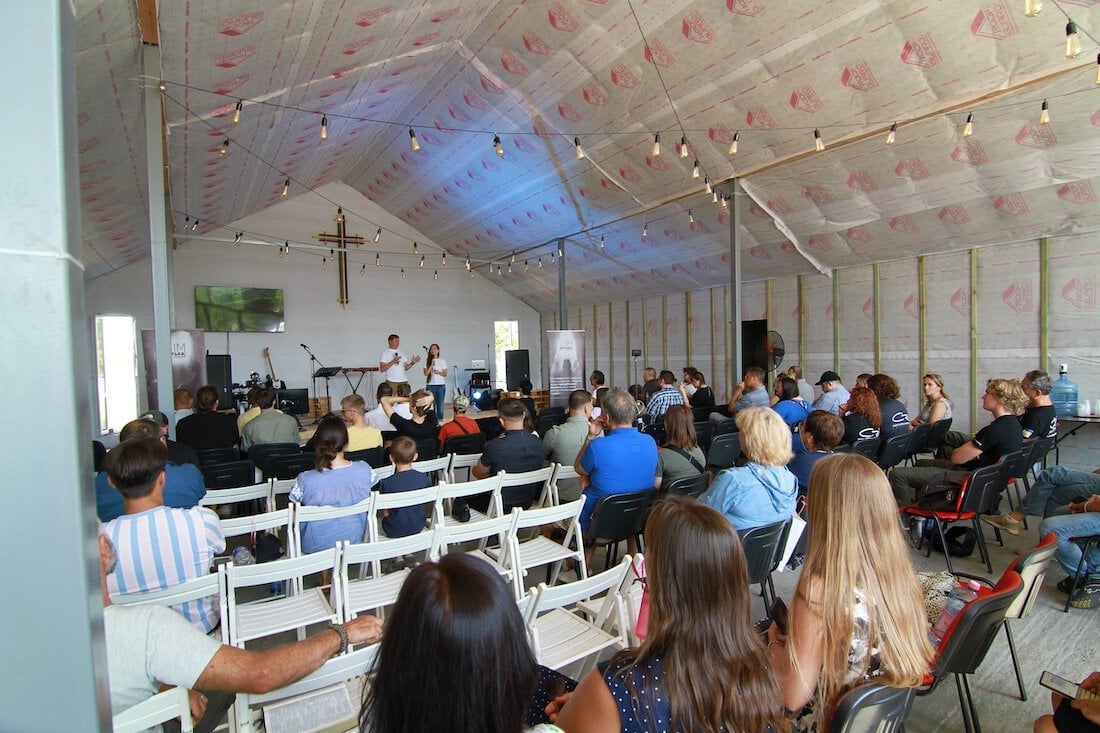
A beleaguered people strengthened together by faith. Sergey’s message was moving.
Too soon my time with Igor and Anna was coming to a close so I saddled up the big GS and rode for the town of Yhuzne just outside Odesa. I had met a motorcycle mad man, Yury Tkachuk, the year before in Odesa and we had kept in touch via social media. Yury used to put on a big motorcycle enduro every year before the war, and now finds himself very busy building and preparing cars and motorcycles for the Ukrainian military.
The town of Yhuzne on the Black Sea was once a thriving tourist town with a big resort hotel dominating the city center. Now there are no tourists, the beaches are blocked off with barbed wire as they are heavily mined, and life in Yhuzne apart from the constant air alerts is quiet. Yury takes me to a favorite restaurant for lunch and then we join his young children and some others from the neighborhood, in a very special project. Yury has been preparing an SUV for his military friends in his work shop, and now that it is fully serviced and painted NATO green, it’s ready for camouflage. He and the kids head behind the garage to cut tree limbs. Minutes later I watch them spraying the car with different colored paints holding the branches full of leaves to make the car’s markings. As I think about this vehicle’s intended use on the battlefield, it’s one of those moments that just doesn’t seem real as I watch these small children engaged in an activity unique to war.
The hotel in Yhuzne is being run by a skeleton staff and has no amenities so I decide to move into Odesa as I have some people to see. Little did I know it would start the most incredible chain of events as I went online and booked the hotel we had stayed in the previous year. Right in the center of the city, off site, locked parking, it’s extremely clean and comfortable for a very low price. I said my goodbyes and rode in.
The morning the rockets flew
I was following some stories about the Rotary Club and spent an afternoon with a charming couple, Mykola and Olga Stebljanko, learning about their work with Rotary. As residents of Crimea, they had already lost everything after fleeing occupation in 2015, and now the outbreak of the full-scale invasion had taken everything again. It hasn’t crushed their indomitable spirit and over coffee in an upscale Odesa restaurant they recount their lives. As with everyone in Ukraine, it all starts at 4.a.m on the morning of February 24th 2022 when the “rockets flew.”
Mykola and Olga have to leave, but ask if I’m interested to talk to a fellow Rotarian, Kate Rotarenko, about her work as a dead body collector and also a friend Yulia Gladkaya who lived under occupation in Kherson. Yulia is now an internally displaced person and works for a charitable organization helping others in her position. I agree to both interviews, set up phone contact and say my goodbyes.
My time with Kate was eye opening. Spending the afternoon with her team at their facility, and learning about something I would never have ever thought of in my life while seeing the private folders of images they compile for their records of the bodies, was shocking.
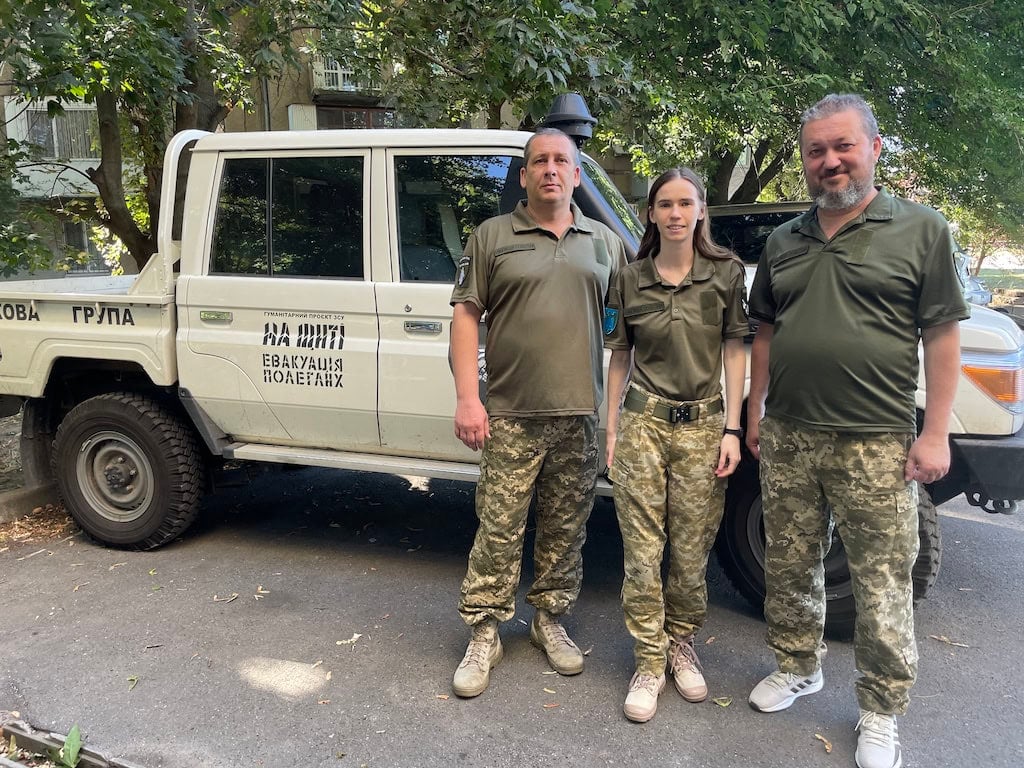
Kate and her team. Its heart-breaking, somber work, but they love their people.
Leaving Kate I rode out around the ring road that skirts Odesa and made my way back to the historic district where I was staying. The modern shopping malls and stores lining the road are busy and traffic is dense so progress is slow. Once back into the city I ride the cool, tree lined avenues navigating now by memory and soon I’m back in my hotel processing photos and notes.
My next interview is with Yulia. A resident of Kherson before the full-scale invasion, she endured seven months of occupation before fleeing with her children to Odesa to start her life over again. Within a few days she went to work for an organization called Winds of Change helping other internally displaced people and when she asked if I wanted to see the work she and her team are doing, I could never have imagined the day we would have.
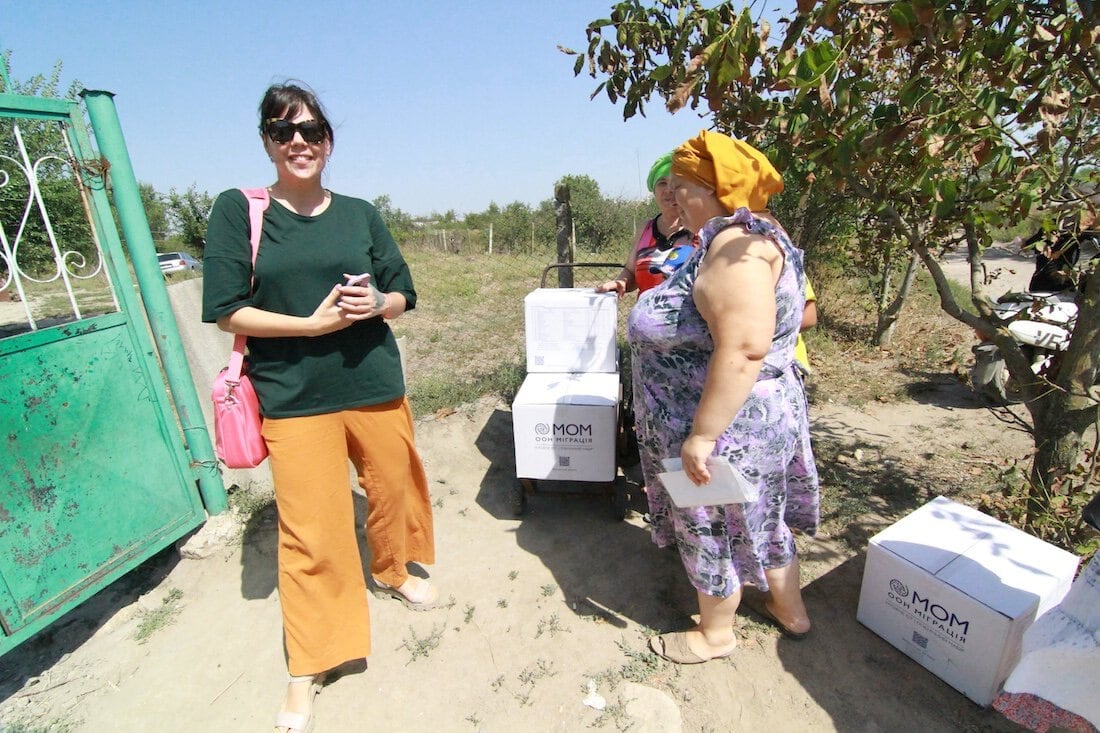
Yulia with some of the internally displaced that Winds of Change helps care for.
Saying goodbye to Yulia, she asked if I would like to interview her friend Roman. A resident of Kherson, he had been rounded up by the Russians, imprisoned and tortured for 54 days and is lucky to be alive. That interview led me to a lady named Viktorria, and a few days later I was touring her drone-making facility and getting ready for one of the wildest days of my life.
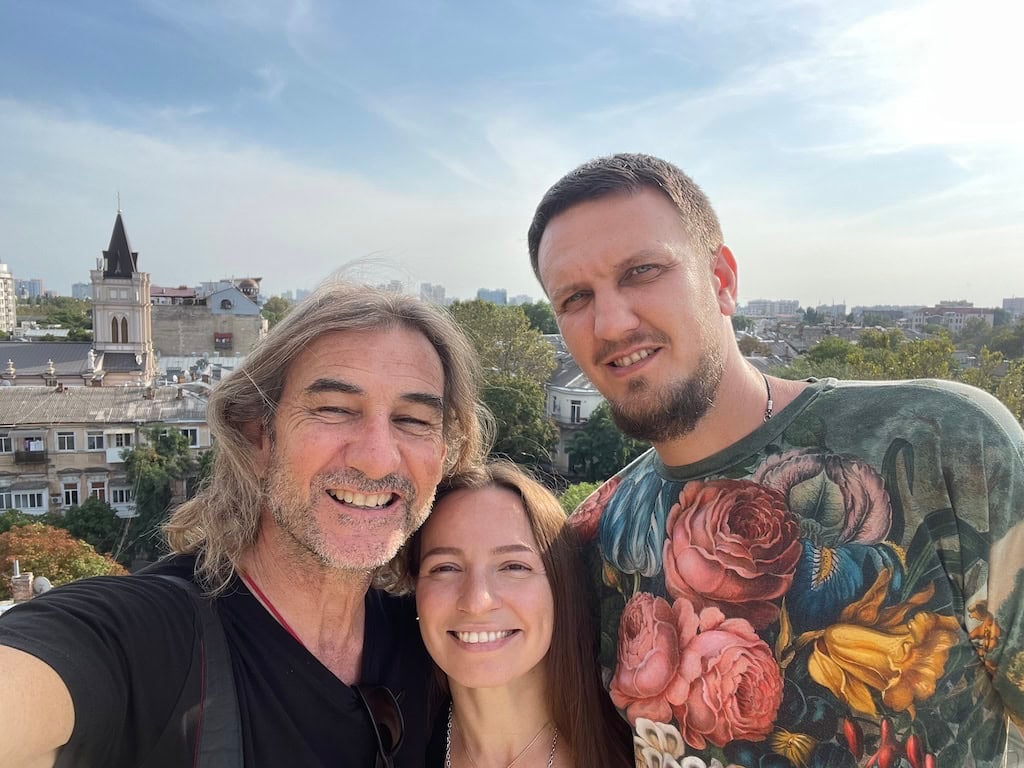
Neale, Viktoriia and Roman. They have endured the unimaginable.
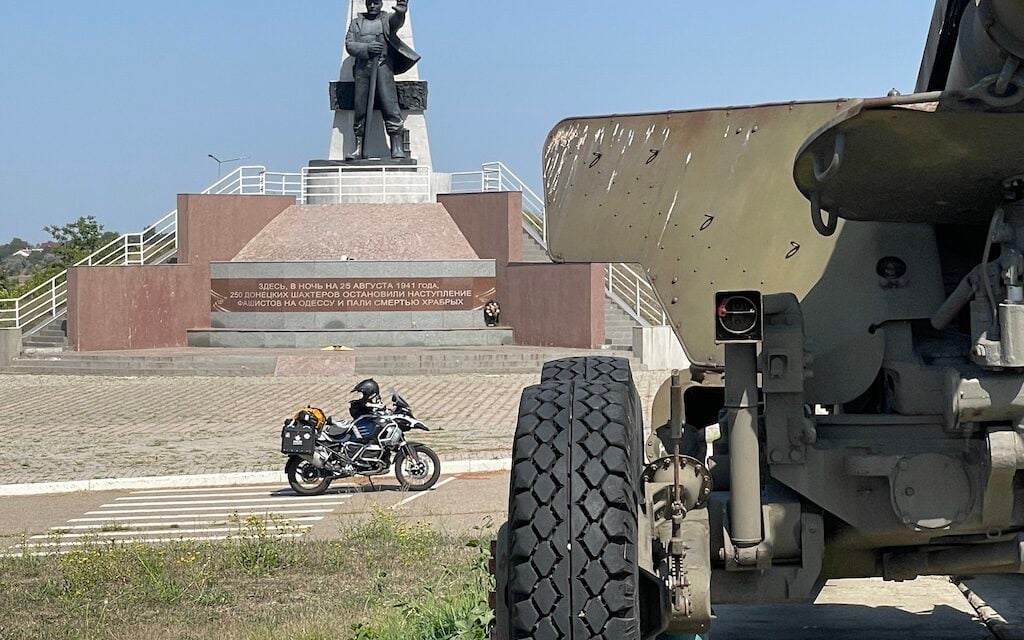
During my time in Odesa things were fairly calm. There was an anti-missile position near my hotel, which was loud at times, and one day on my way back from visiting Yury a drone or missile was shot down close by as I stopped to photograph an old war monument. (top photo)
There was a tough day out with Yury to visit a close friend of his in a military hospital in Odesa. He had been caught near Russian trenches laying mines and they opened fire exploding one of the mines and leaving him with a severe brain injury. The hospital was very strict on no cameras, and not very happy to let me in, but Yury came bearing bags of snacks and drinks for his friend and is very persuasive so in we went.
It was clean and efficient inside, but the number of injured soldiers was sobering and it was hard to see the condition of Yury’s friend. No one said it was going to be easy going into a country at war. We spent some time visiting, and chatting with the other soldiers in the small room recuperating from various injuries, and headed out for a tour of Odesa. Yury wanted to show me some of the damage done by Russian missiles, and between the large cathedral, a massive office complex and some residential buildings it is just impossible to understand the mindset of a people who can deliberately kill innocent civilians in their homes and at work.
My time in Odesa came to an end and after saying my goodbyes I rode out to Yuzhne for a last visit with Yury and his friends. By this time the young soldiers on the block post recognized me on the BMW so just smiled and waved me through. As I rode out along the Black Sea with all the ports and equipment lying dormant my mind had a chance to run over the last week and how I’d been led from story to story and experience to experience.
Back on the open road the following day my destination was Dnipro City, and another meeting with some Rotarians so I stay on the gas to make my afternoon appointment. The two-lane highway quickly leaves signs of civilization and as far as the eye can see there are sunflowers and wheat. Small towns, light traffic and the occasional ear worm of “what will I do if I break down out here.” Maybe just a little of the stress of the last week escaping as I couldn’t really see the GS letting me down.
What will I do if I break down here?
I found an interesting hotel right on the Dnipro River close to the center of town and quickly readied for my meeting. Soon, two well-dressed gentlemen showed up in a nice saloon car and I was whisked off for another tour of the destruction Russia has caused to their city. It gave us the opportunity to talk about the work they are doing with Rotary, and like all the other Rotarians I met, the scale of the support they have been giving is herculean.
The level of destruction at one of the apartment complexes we visit is beyond shocking, even after all I have seen and experienced already in Ukraine. Just the same mind-numbing realization of how many innocent people were murdered in their beds just not making any sense. A big office building, the local train station and more, grotesque, burned and twisted remains of lively facilities that now stand as tombstones to the dead.
The guys don’t have a lot of time and have me back at my hotel before dark. I thank them for their time, finish some notes and stroll to the water to eat dinner in one of the private cabanas. The food is excellent, the service the same and my waiter speaks a few words of English. Dressed in a traditional Ukrainian shirt, his pleasant demeanor suddenly changes to one of angst when the air alert begins to howl across the city one more time. He clutches his ears and shakes his head as if trying to erase the noise from his consciousness and rid himself of the memories it brings back.
Fleeing the invading forces with his young family in February 2022, his wife and son now live in Poland and he only sees them on FaceTime. He is literally working around the clock, was my breakfast waiter the following morning, and lives in an extended limbo of uncertainty as the sirens slowly drive him mad. With a few kind donors shoving cash in my pockets before I left home, while I couldn’t fix anything for him other than listening, I was able to leave a solid tip. It was the way he was talking about the war before drifting off and staring motionless across the water that got me most. He can make no plans, has no future, and only the fear that one day that siren will mean a missile is coming his way.
I left in the morning with little break from the sirens and made my way along the Dnipro River. A curiosity stop saw me in a Harley-Davidson dealership, and then I was back into the country. More of the same with fields of sunflowers and grain, my only company for hours. Out alone with my thoughts, the omnipresent “what am I doing here” was waging its now normal battle when I pulled into a gas station, went inside and asked a lovely elderly lady where the bathroom was. She smiled and with sign language pointed it out, and moments later as I drank my coffee outside she came out to join me.

Back on the road my heart was full. The warmth of her smile and embrace, and the knowledge of what I was doing here just lifted me as I rolled through the beautiful countryside. My mood was good and I was happy to have some positivity about me as I knew Kharkiv would be tough. Located less than 25 miles from the Russian border it gets hit hard almost on a daily basis, but I had one more Rotary contact to visit and it would give me the chance to see my dear friend Olena Kurylo.
Olena was the first person in Ukraine to be injured by Russian missiles, her apartment destroyed and her face badly cut and bleeding, her image ending up on newspapers all around the world during those first days of the full-scale invasion. I had visited her in Poland as she underwent multiple surgeries to restore the sight in her right eye, and now she was back in her hometown, a short train ride from Kharkiv.
As I was drinking coffee the following morning, fate delivered another incredible chance meeting and subsequent interview with an Englishman called Gordon Jackson Hopps. Gordon started a small organization called “Operation Freelander” and was delivering a fully restored Land Rover Freelander full of supplies to a local military unit.
Olena joined us for coffee and then we took off for a walking tour of the city while Gordon took care of some business in town. The weather was spectacular and we ate lunch in a local restaurant serving authentic Ukrainian dishes, before strolling through the park and visiting the dolphinarium and aquarium. Making our way past badly bombed out buildings, with constant air alert sirens filling the city with their blood curdling howl, it was a day of very mixed emotions. It was great to see Olena, and I know she enjoyed some company and maybe a break from the stress of everyday life under constant missile attack. I put her on an afternoon train home, enjoyed a nice meal with Gordon before crashing out to the sound of sirens.
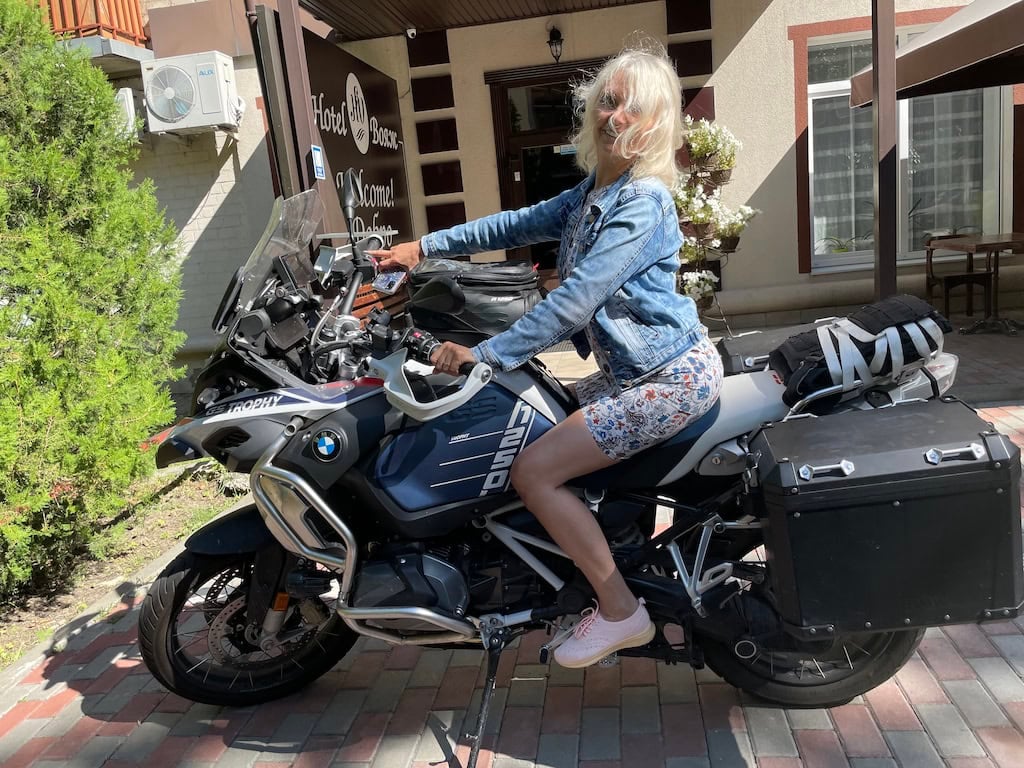
Olena, joyful and unbroken. She inspires me.
The following morning I met with my last Rotary contact, learned about the underground schools they are building and other projects they have been undertaking in the support of people who end up with no home, food or income. Incredible is a word that springs to mind. Getting on the road I stopped by to see one of his project schools on my way out of town and was given a tour.
It’s been undergoing renovation from earlier bomb damage and a whole school area has been built under the building, with a ready-made bomb shelter where the children can be safe and continue learning. It’s another of the constant list of situations that just bend my mind as it seems so insane this is happening in 2023. Where is the world’s outrage?
The road back from Kharkiv was long and it was well into the evening when I hit Kyiv and headed out into the country to Igor and Anna’s for a last visit. They were happy to see me, Kitty the dog was tormenting the cat and the night was fairly quiet in regard to incoming missiles.
My ride to Lviv the following day took around eight hours and it was early afternoon when I checked back into the Loft 7 and went to dinner with Andriy. I took one last visit to Superhumans, said my goodbyes and sadly turned the GS toward Munich. A few days’ ride would see me boarding a flight to the UK for time home with my friends and family. Where on my ride into Ukraine I had been fighting confusion and doubt, I now had a clear understanding of my purpose in Ukraine during this trip, and the smooth, calm roads of Europe gave me the time to start putting it all in order.
Neale Bayly
For more on Neale’s foundation, click here:















Great stories, I even forgot some, and you reminded me)
Nice. Thank you for your support and help!
OMG You made me cry how brave they all are! You too for being a witness to the atrocities committed by greed and unconscious people toward innocents. I want more of your trip. Thank you so much for doing this journey.
More indeed to come.
Thank you for the kind words