


Will Roberson sheds light on the unique history and subculture of the legendary Vespa scooter
Editor’s note: For many of us in the motorcycling world, William Roberson needs no introduction. A long-time moto journalist, Will has been writing for motorcycle mags, automotive publications, travel periodicals, and notably, Forbes.com, for many years. He is one of America’s foremost motorsports writers, but even more to me, Will is a dear friend. It is a thrill and honor to feature this story, written specially for Road Dirt, about one of Will’s most sincere passions, the historic Vespa motor scooter.
While I’m a dedicated and proud motorcycle rider, I usually keep a scooter in the garage as well, and it’s usually a Vespa. Currently, I have a 2014 Vespa GTS300ie Super, the hottest hot rod the company made at the time. I’m also President of Vespa Club Portland, a vibrant and active group of scooter enthusiasts—“scooterists”—who ride year-round in the often damp Pacific Northwest. And in case you missed it, 2026 marks the 80th anniversary of the Vespa scooter.
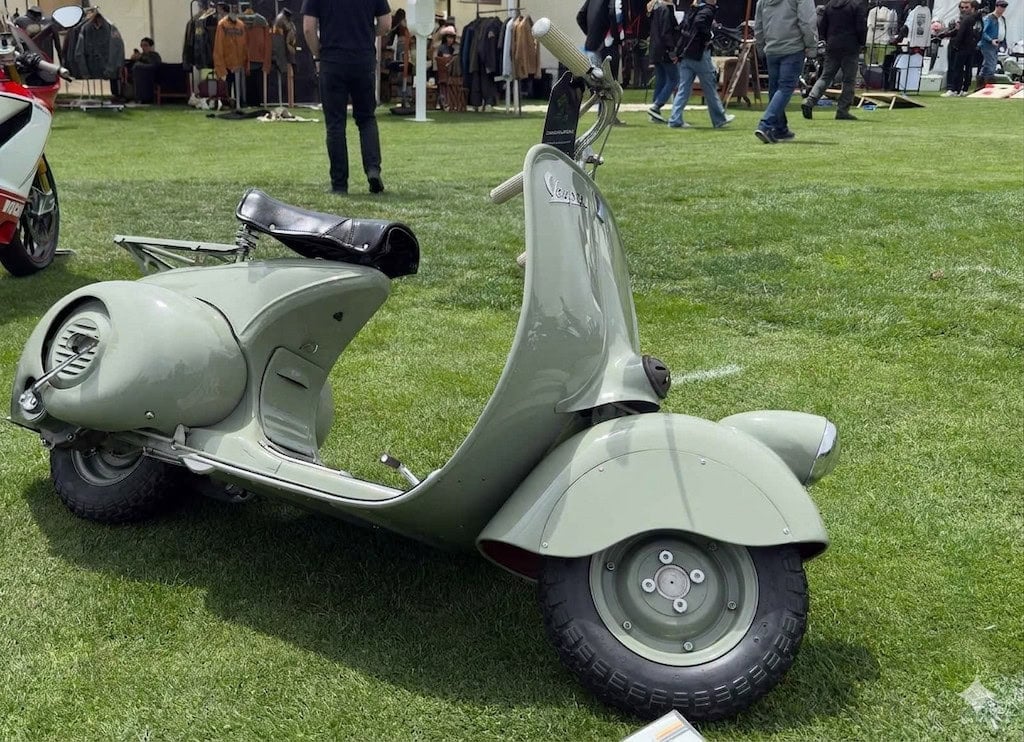
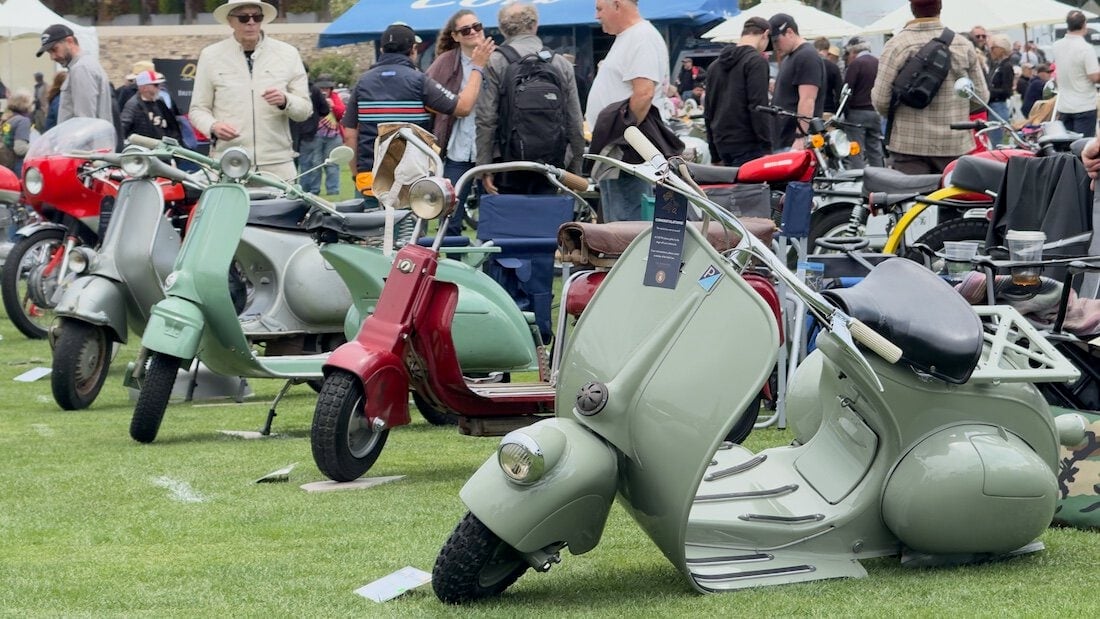
1946 Vespa, Piaggio’s first scooter for the masses.
Vespas were born out of desperation. After World War II, much of Italy’s infrastructure and manufacturing capacity lay in ruins from Allied bombing. Impoverished and defeated, Italians struggled to survive the post-war years. Italian vehicle and aircraft maker Piaggio saw an opportunity to get people moving again and appointed an aircraft designer to create a lightweight motorbike that was affordable, tough, and utilitarian. Being Italian, it also had to have a decent sense of style. As it turned out, the scooter’s designer absolutely hated motorcycles, so he designed the anti-motorcycle: a diminutive 98cc two-stroke machine with a curving front splash guard and a step-through design that would keep mud off riders’ pants, dresses, and shoes as they navigated often muddy roadways. With a curvaceous “abdomen” concealing the engine, the Vespa—which means “wasp” in Italian—was born, and the perky, buzzing scooters were an immediate success.
I bought my first Vespa in college. It had changed hands innumerable times and was held together with duct tape, twist ties, and prayers. It was hard to start, smoked a bit while running, leaked oil, and ate clutch cables. But it had that inimitable Italian charm, and many a co-ed asked for a ride to campus or back to their dorm on my plucky rattle-can green P200E. Helmets? And mess up my carefully coiffed 1980s haircut? Never!
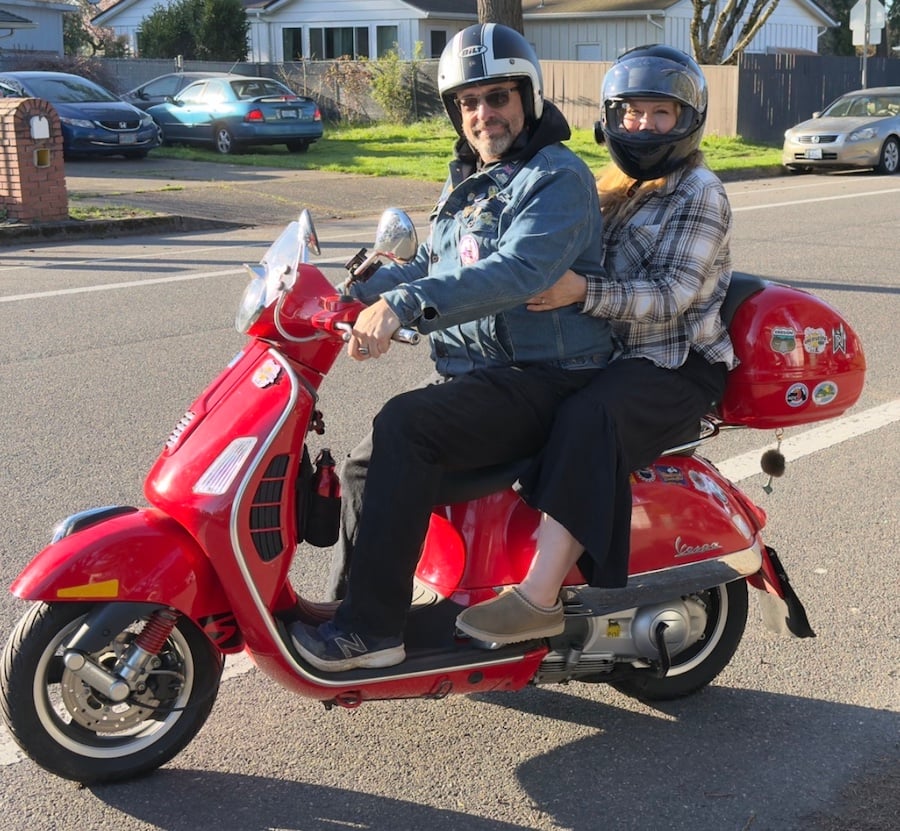
Will and his wife’s friend, on her first scooter ride.
For those who ride Vespas, it’s both a way to get around and, depending on how enthusiastic they are, something like a cult, a religion, and a mechanical obsession. The only other group of riders I’ve seen as dedicated to a brand would be Harley-Davidson owners. Indeed, scootering itself is a religion to many riders, regardless of brand, but Vespas seem to command the most passion, along with owners of Vespa’s former chief competitor, Lambretta. In rainy Portland alone, there are at least seven active scooter clubs.
Why ride my Vespa when my motorcycles are faster, larger, and ostensibly more comfortable (sportbikes excepted)? There are many reasons, but I’ll just cop to the main one: It’s fun. Simpler, slower-paced fun. Stylish fun. Affordable fun. And modern Vespas like my GTS300ie Super are, for scooters, right quick. My Vespa can touch 85 mph flat out, and I ride it on local freeways without reservation. The modern liquid-cooled, fuel-injected, oil-tight four-stroke single-cylinder engine makes about 26 horsepower, and as scooters go, it’s roomy and comfortable. It also gets about 80 miles per gallon, so it’s very efficient compared to any gas-powered car (including hybrids) and all of my four motorcycles.
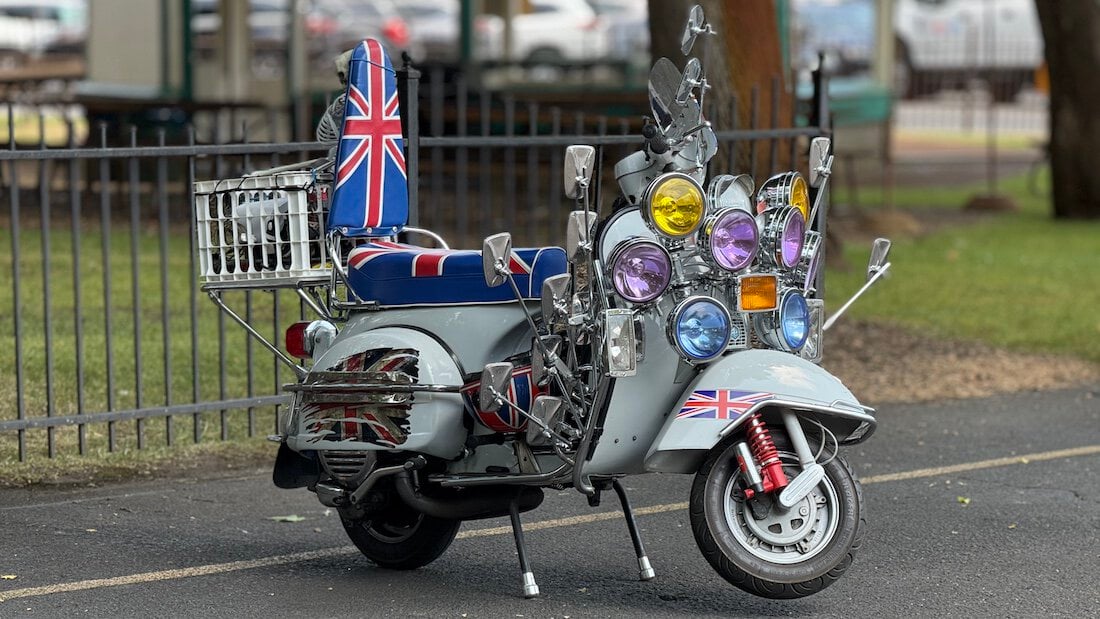
A super-modded Vespa Classic, at the annual Amerivespa rally. Can you say, “Quadrophenia”?
And as any rider of a small-displacement motorcycle like a Grom or a 300 cc-class moto will tell you, scooters are absolute scythes in urban traffic. On a technical note, all Vespas (and pretty much any scooter from any company today) are “twist-and-go” because they use a stepless CVT transmission instead of a clutch and gears, as on my old P200E. Less fun for enthusiasts, clearly, but this also makes them much more accessible to non-enthusiasts who just need simple, affordable, reliable transportation. Today, over a billion scooters are on roads worldwide, mostly in Asia and the EU. In the U.S., scooters are still mostly viewed and used as recreational vehicles, although on my recent trips to New York City and other major metropolises, they are increasingly used as delivery workhorses and yes, as affordable basic transportation. And really, that’s how it should be.
In 2023, I was on assignment in Milan and tacked on a couple of extra days to see the city. I rented a Vespa 125 to tour the renowned fashion capital. Initial observations: Roads in Milan are a gauntlet of crumbling pavement, trolley tracks, potholes, construction patches, buses, cars, scooters, and unfamiliar road signs. At least they ride on the right (as in, right) side of the road! Second: It seems native Milano scooterists ride like suicidal maniacs, but in truth, they are generally expert riders. They use every car lane, bike lane, sometimes the sidewalk, and any other open space to carve through traffic. I don’t know if lane splitting is actually legal in Italy, but if it isn’t, there’s zero enforcement because everyone on two wheels does it. Many of the scooters I saw lacked mirrors, unsurprisingly. And most riders on a Vespa in Italy were impeccably dressed.
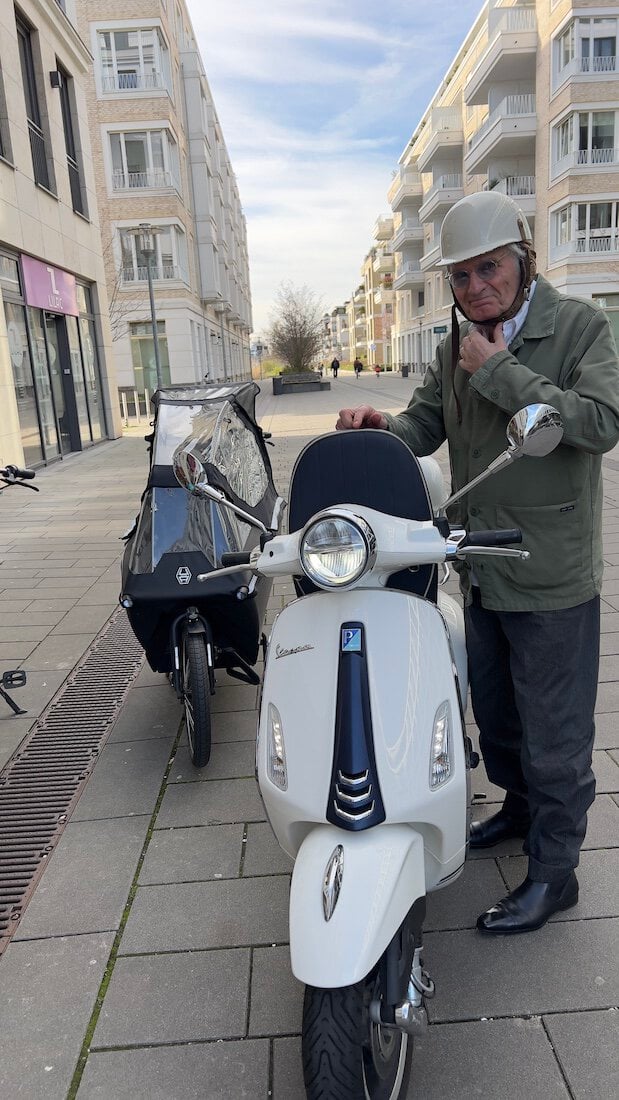
Typical Vespa rider in Milan, Italy. Impeccable, man and machine.
Coming from Oregon, where lane splitting is illegal, I was by far the safest rider on Milan’s streets, patiently waiting behind vehicles at traffic lights. I may as well have worn “tourist” on the back of my riding jacket. Soon enough, however, I was trying to keep up with the locals, many of whom were on Vespas, while others were on Asian brands like Kymco, SYM, Yamaha, Genuine, and many Chinese machines, some fully electric. There were also a large number of BMW scooters, and the three-wheeled variants like the Piaggio MP3 and Yamaha Niken were common.
In Milan, and in Italy in general, it seemed like there was a scooter for about every two cars. There’s good reason for the popularity of scooters, beyond their effectiveness in traffic: Scooters (and some microcars) park for free in vast curbside sections reserved for motorbikes, while cars have to circle to find a parking spot – and then pay to park. Scooters are also allowed to park on sidewalks and curbs as long as they don’t block pedestrian right-of-ways. Everywhere you look in Italy, scooters are tucked into doorways and every nook and cranny of public space. At night, as I lay in bed in my Airbnb apartment with the windows open, the hum of scooters zipping by was like an Italian mechanical lullaby.
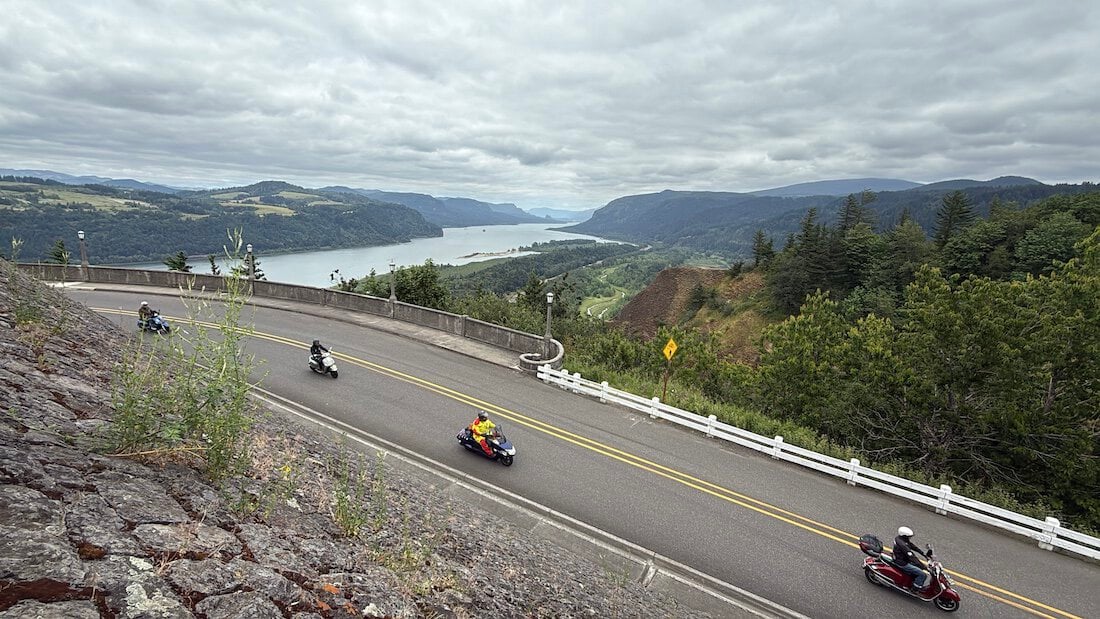
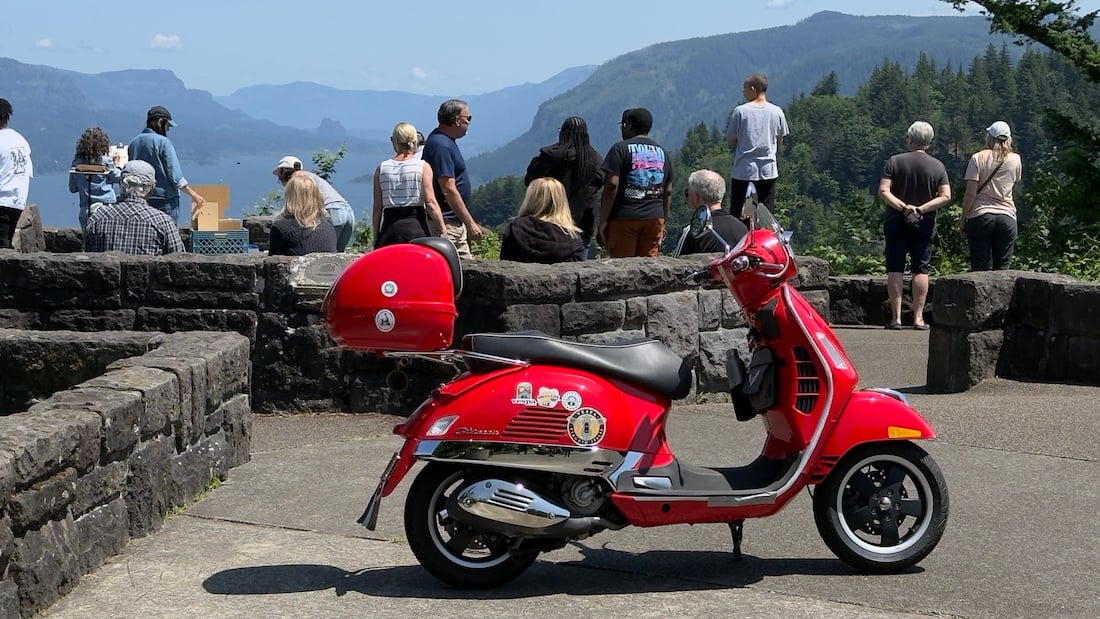
Riding around the Columbia River Gorge during the annual Amerivespa Rally.
Back in Portland, as in most American cities, it seems there are a million cars for every scooter. Car culture rules here, which makes riding a scooter feel a bit more… exclusive. Most places I go on my Vespa, someone comes up to ask about it. Some ask how I like my “moped,” and I have to gently remind them that it’s a scooter, not a moped, which has pedals (motor + pedals = moped) and is usually 49cc max. Most are shocked to learn it’s freeway legal, but for the most part, the Vespa always provokes a positive interaction. When the Vespa Club of Portland gathers for a group ride, we often go through a popular shopping section of the city. People stop to watch our group motor past. Kids wave, adults take cell phone pics, and people smile. When we stop at The Vern pub, Salt & Straw ice cream, or one of the many food cart pods in the city, people invariably wander over and ask questions about our club and riding scooters. We try to be positive ambassadors.
In 2025, Portland’s scooter clubs hosted Amerivespa, the annual Vespa national rally. Hundreds of scooterists brought or rode their machines to the Pacific Northwest, including one rider from Venezuela who completed a year-long world tour on his Vespa, culminating at the rally. There were rides to the Oregon coast, into the Cascade foothills, and all around the city as well as skills tests, gymkanas, and show-and-shine events. On one day, my club led a group ride of hundreds of Vespa scooters through the city to an amusement park on the Willamette River. As we stopped at a light partway through the route, I looked back and could see scooters for blocks and blocks behind the ride leaders – an amazing sight. While scooters are undeniably fun, scooter riders – scooterists – are also a great community. And as motorcyclists, we know the value of that kind of community. So the next time you’re out riding and see a scooter, give them that friendly wave, just as if they were on a sportbike or cruiser. We are all part of the larger motorbike family.
Will Roberson
*Top featured photo: Atop the Columbia River Gorge overlook















Really nice to view your publication for the first time. I was a Vespa rider for years. Have owned 3 GTS’s for a total of 92,000 miles. Been across the USA coast to coast 4 times, toured southern Canada from coast to coast. Been to Key West and back from Olympia, WA.
Parkinson’s got a hold of me. Rode for a while with PD, until I just had to stop, riding and driving.
Look forward to your publication of future issues!!
Welcome, Randy! You’ve seen some amazing sights/sites in your coast-to-coast travels, I’m sure.
Saddened to learn of your condition, prayers for you, and I hope you’ll keep inspired and encouraged by reading our stories here.
Best to you,