

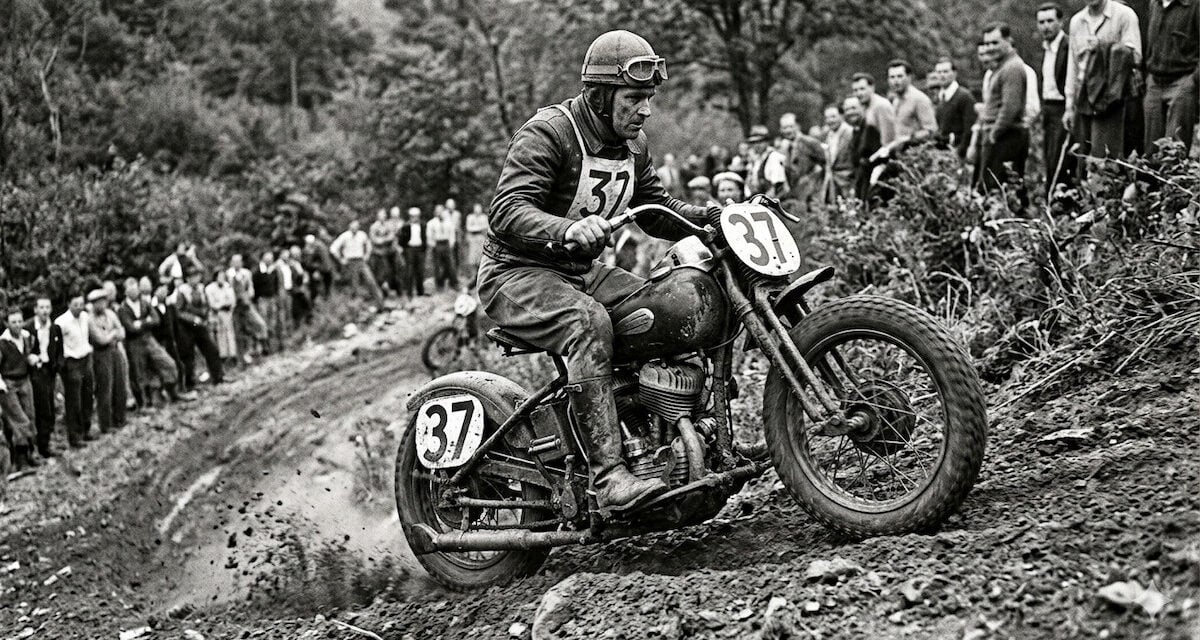

A brief history of the most basic form of motorcycle racing
We recently received a press release from the AMA about their August hill climb races. The sight of stretched swingarms, crazy knobby tires digging and slinging rooster tails of dirt, and the steep hills these bikes and riders were attempting to ascend as fast as possible, just arrested our attention. Motorcycle hill climbing is as wild as it looks.
Few forms of motorcycle racing are as simple—or as spectacular—as motorcycle hill climbing. The basic premise is straightforward: point a motorcycle up a steep hill and see who can reach the top the fastest, or at least climb higher than the competition. Yet behind that simple concept is more than a century of motorcycle racing history, innovation, risk-taking, and colorful personalities. Hill climbing emerged during those early days of motorcycling, when riders were still discovering what their machines could do and manufacturers were eager to prove that motorcycles were more than simply motorized bicycles.
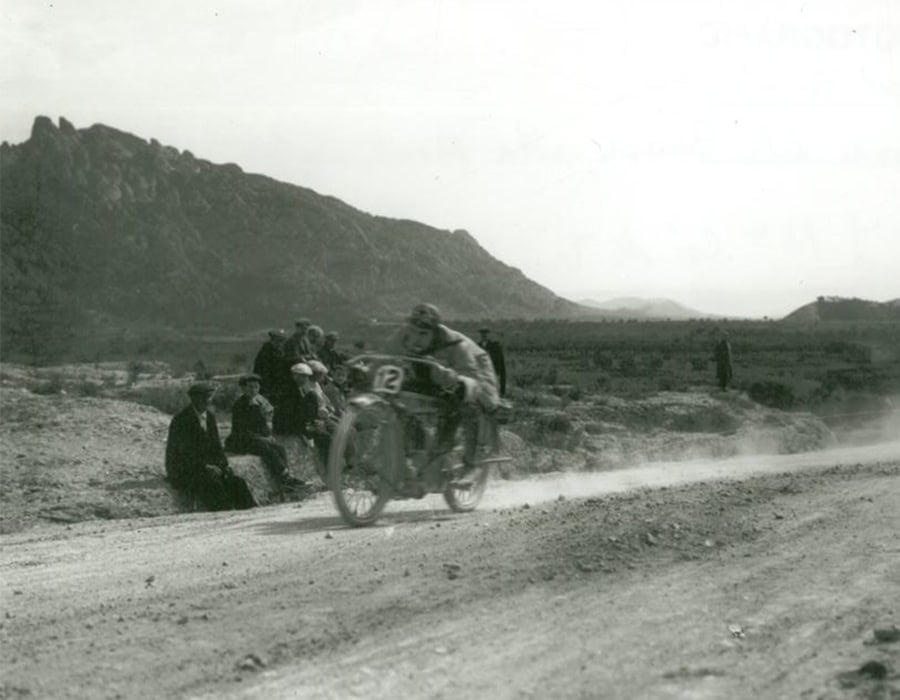
Pujada als Brucs Hill Climb, 1913. Reial Moto Club de Catalunya / Wikimedia Commons. Public Domain.
Motorcycle hill climbs began appearing in the United States in the early 20th century, not long after motorcycles became commercially available and accessible. Organized motorcycle racing was still in its infancy, and riders competed in a variety of events, including road races, endurance contests, dirt-track races, and reliability trials. Hill climbs offered an especially appealing test because they required relatively little infrastructure compared with a road-racing circuit. A suitable hill, a starting area, and a crowd were often all that was necessary. One of the earliest and most famous venues was Mount Tamalpais in California, where motorcycle hill climbs became a major attraction during the 1910s-20s. Events such as these helped establish hill climbing as a legitimate form of motorcycle competition.
By the 1930s, hill climbing developed into a more organized form of competition, particularly in the U.S. Manufacturers and motorcycle clubs recognized that the sport provided an excellent way to demonstrate engine performance, traction, and durability. The machines used for these contests were often based on motorcycles that could also be ridden on the street, but competitors quickly discovered that modifications could make a dramatic difference. Lower gearing, increased engine performance, stripped-down chassis, specialized tires, and changes to suspension and weight distribution all became part of the hill climber’s arsenal. Riders also developed increasingly sophisticated techniques for managing throttle, body position, and rear-wheel traction as they attacked increasingly difficult slopes.
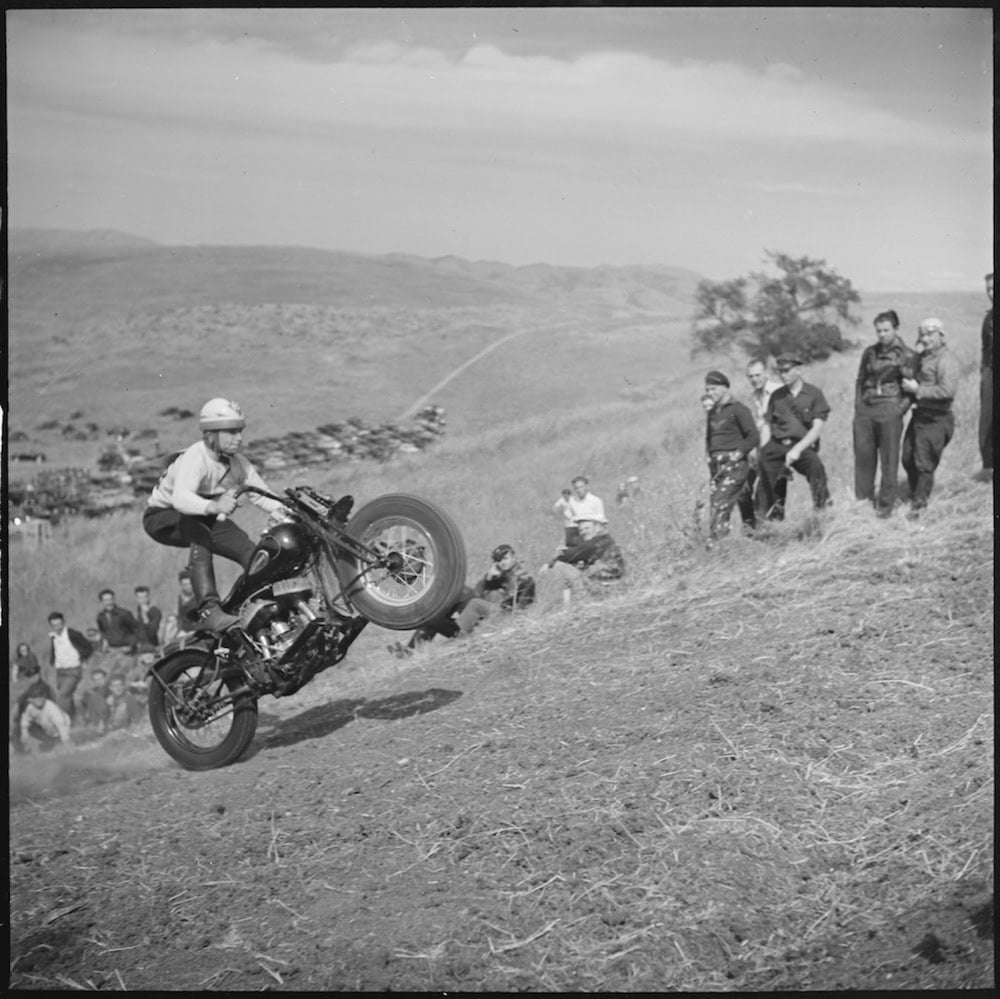
Motorcycle and Hill Climb Recreation, Santa Clara County, California, 1940. U.S. National Archives / Wikimedia Commons. Public Domain.
Following World War II, motorcycle hill climbing entered another important era. The growth of American motorcycling and the popularity of organized motorcycle competition helped the sport become a fixture at fairs, motorcycle rallies, and racing venues around the country. Specialized hill-climb motorcycles began to emerge, and the famous long-wheelbase hill climber became an iconic machine. Builders extended swingarms and frames to keep the motorcycle’s front wheel on the ground as riders attempted to conquer increasingly steep hills. Some machines eventually became almost purpose-built climbing machines, with enormous rear tires, extremely long chassis, powerful engines, and minimal bodywork. The spectacle was every bit as important as the competition: a motorcycle launching up a dirt hillside with its engine screaming and its rear tire throwing arcs of dirt became one of the defining images of American motorcycle racing.
By the 1960s, 1970s, and 1980s, hill climbing had developed a devoted following and a distinct culture of its own. Events featured multiple classes based on engine size, motorcycle type, and level of modification, giving both amateur riders and professional competitors a place to compete. The sport also became an important proving ground for engine builders and chassis designers. Four-stroke singles and twins were particularly prominent, while later generations of riders experimented with increasingly powerful multi-cylinder engines. The objective wasn’t simply to make the most horsepower possible. Too much power could overwhelm the rear tire and send the motorcycle sideways or flipping backward. Successful hill-climb machines had to balance horsepower with gearing, traction, weight distribution, and rider control.
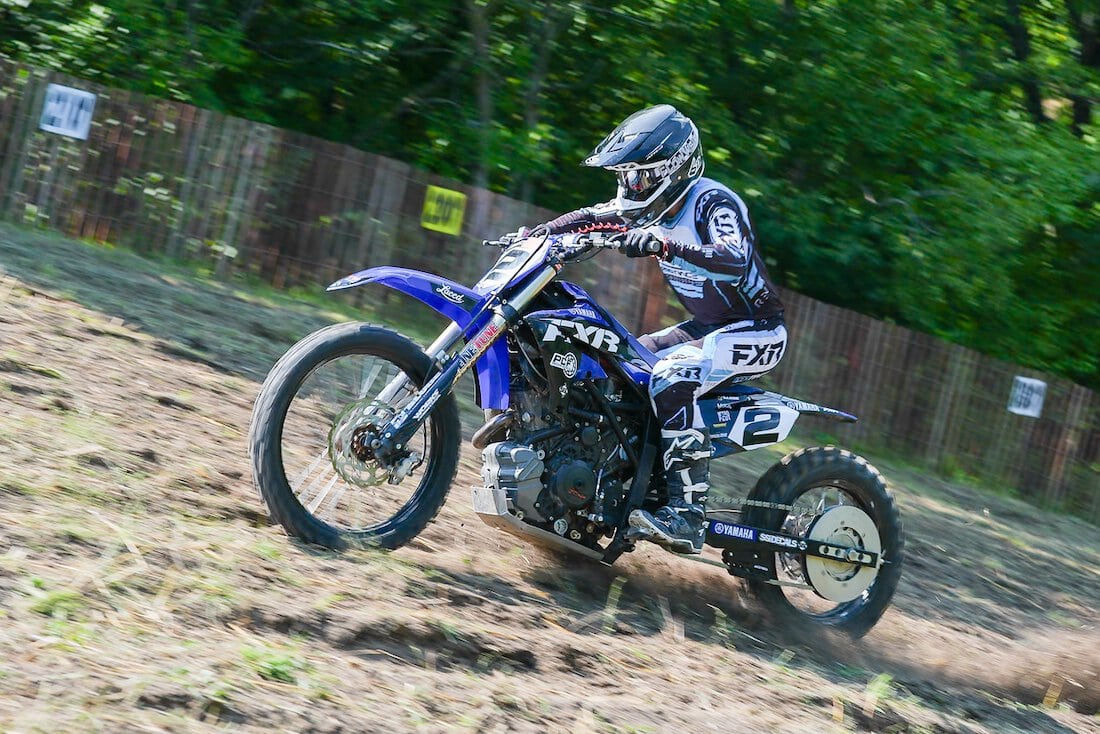
2026 AMA Hillclimb Grand Championship, New Ulm, Minn., hosted by the Flying Dutchmen Motorcycle Club. Photo by Chris Wenner/AMA
The sport has continued to evolve in the modern era, with contemporary hill climbs featuring everything from relatively conventional motorcycles to highly modified machines producing extraordinary amounts of power. Modern suspension technology, improved tires, fuel systems, electronic engine management, and sophisticated chassis design have expanded what riders can attempt. At the same time, the fundamental challenge remains unchanged: find traction, control the motorcycle, and climb farther and faster than anyone else. Some modern events have become major motorcycle gatherings, attracting competitors and spectators from throughout the country. Organizations such as the American Motorcyclist Association (AMA) have also played an important role in sanctioning and supporting motorcycle hill climb competition in the United States.
What makes motorcycle hill climbing particularly interesting is that, despite its technological evolution, the sport has never lost its connection to the earliest days of motorcycling. There is no complicated track layout to memorize and no elaborate strategy involving pit stops. Instead, it’s an almost primitive test of man, machine, and terrain. From the pioneers who struggled up California hillsides on early motorcycles to today’s competitors attacking seemingly impossible slopes on purpose-built machines, the objective remains remarkably consistent. Motorcycle hill climbing has survived for more than a century because it represents one of the purest expressions of motorcycle performance: point the bike uphill, pin the throttle, haul ass uphill, and see how far/how fast you can go.
Rob
*Please check out our sponsors, here below and above this article. They help us pay the bills.























0 Comments