

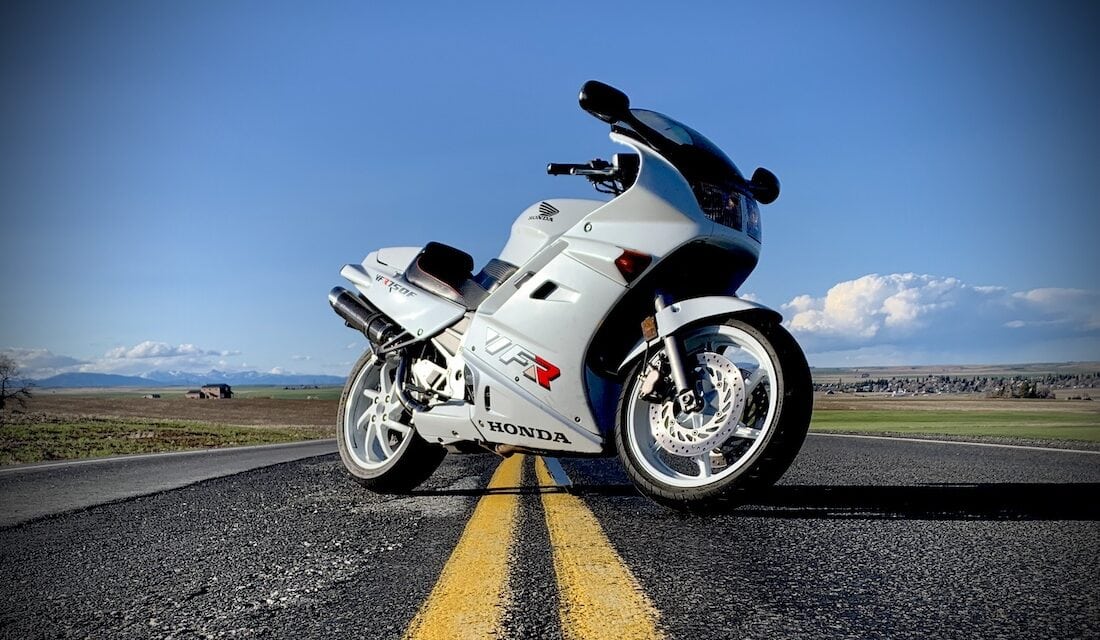

Returning to the heart of motorcycling
In a digital world driven by touchscreens, scrolling menus and artificial intelligence there lives a Unicorn, a 1993 VFR 750. In this electric world measured by binary strings of 1s and 0s she is a deliciously analog endangered species driven by feel, a deft but heavy touch, proper feel at the levers. Her cockpit is full of spinning number odometers and sweeping white needles on black numbered faceplates that don’t disappear when the bike turns off. When I feel saturated by screen time and need to unplug and return to the heart of motorcycling, the core of who I am, I ride The Unicorn.
It is an early summer morning and at this latitude the sun has been shining bright since 5:00 am. Wife and dogs still asleep I don my gear silently and quietly roll The Unicorn out into the driveway.
She has no fuel injection, no electronic suspension, no temperature sensors, no LED lighting, no speed sensors, no ride-by-wire, no ABS, no inertial measurement units, no digital gauge clusters, not even a port to charge your phone. There are no ride modes to modulate power, no anti-lift modes to prevent wheelies, no quick shifters to free you from clutch duty, no cruise control to ease the burden of your right wrist and no catalytic converters to cut emissions or mute noise. Each of those electronics sensors and controls are replaced by one single, simple, fallible thing- my brain.
Fine by me.
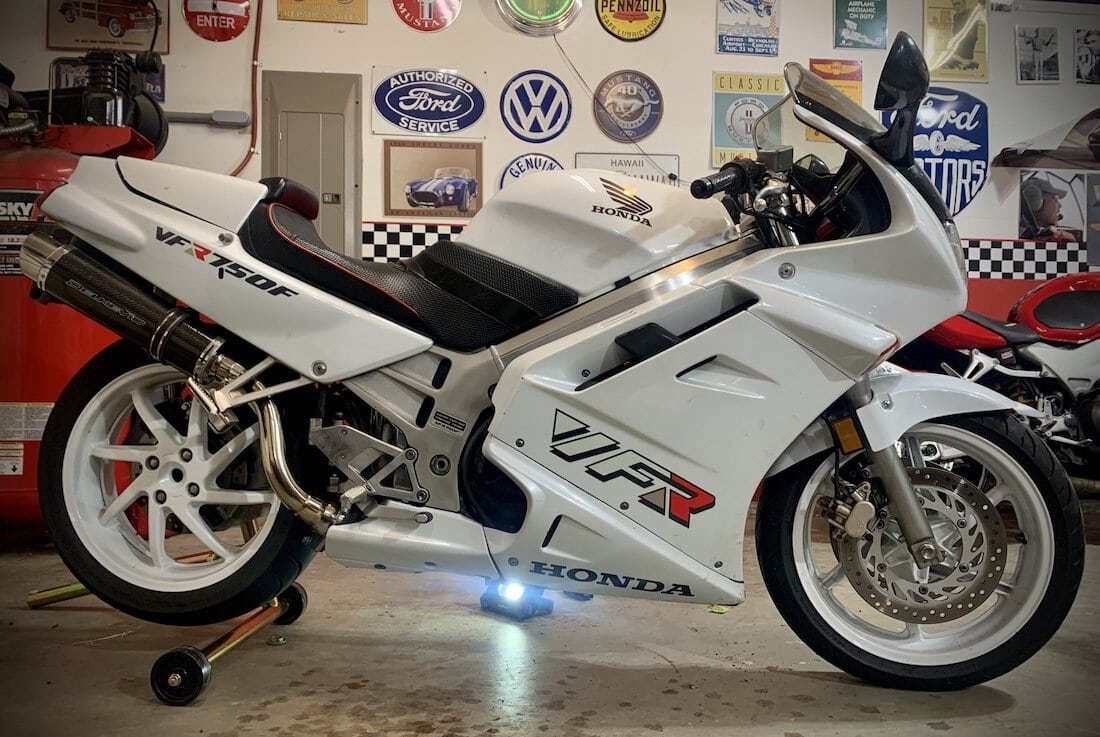
Old bikes mean shop time, old tools and ancient arts.
At startup she asks for a dollop of choke, not too much, not too little, just the right amount correctly calculated by being outside, looking at the cloud cover, feeling the temperature and making minute adjustments as I listen to the speed of the engine trying to fire. Done right she will ignite on two engine revolutions, leaping to life with a small puff of smoke and a high idle.
The bank of four carburetors I spent two days and four burritos rebuilding and tuning when I first acquired The Unicorn from her Oregon barn still maintain their perfect calibration. I know exactly the path the fuel travels, the float levels beneath, the size of the orifices the gasoline is passing though and where the clips are on the needles. No magical black boxes lie beneath, no weird vacuum tubes lie in her belly mysteriously routed with no apparent function, no miles of strange wires I am afraid to break, nothing going on below is a mystery. I have touched it all, put hands on everything and know not all, but most parts intimately. Pulling on my gloves and a helmet gives her carbureted heart just enough time to warm.
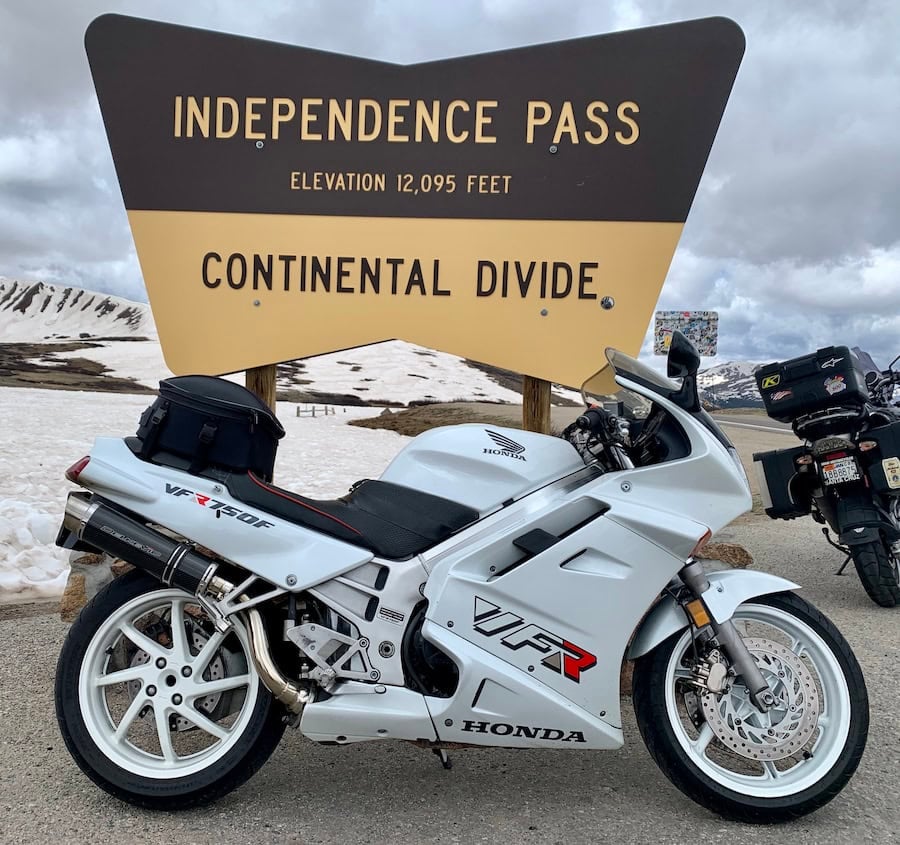
Longer tours are no problem for The Unicorn, but even well tuned carburetors get funny at 10,000 ft of elevation and higher.
I ride her through town and up the nearby mountain road for her morning exercise. Horsepower is meager by today’s standards and riding steeply uphill at this elevation means I can open the throttle with abundant greed, asking the engine bay to give it’s all, a request which The Unicorn gladly obliges. In my mind’s eye I can picture the carburetor needles fully raised up from their seats allowing every drop of gas possible into the passing vacuum. This is full power mode, and is the only ride mode The Unicorn has.
At the end of the long straight the engine is bellowing through open pipes capped with a carbon fiber exhaust with less baffling than a sock, as gear driven cams spin beneath and whine like tiny superchargers. Her V-four scream is half of a V8 firing order and there is no sound like hers, a ripping crossplane-like howl developed decades before crossplane became cool. At 6k RPM she sings, at 8K she rips and at 10k she yells a baritone note that divides the population in two: either you hate carbon emissions and think I am killing polar bears, or you love mechanical music and her exhaust note haunts your dreams like the first time you heard an Indy car rip by at full doppler effect and the hairs on your arms stood straight up in full salute.
I hit the binders hard at the end of the long straight and The Unicorn hunkers down. Heavy she is, requiring a strong right hand on the meager brakes tasked with hauling the steed down from triple digits. Counter steering under braking is also delightfully heavy. You don’t politely ask The Unicorn to turn, you insist, and she obliges. Whole bike effort is physical, demanding, engaging and rewarding.
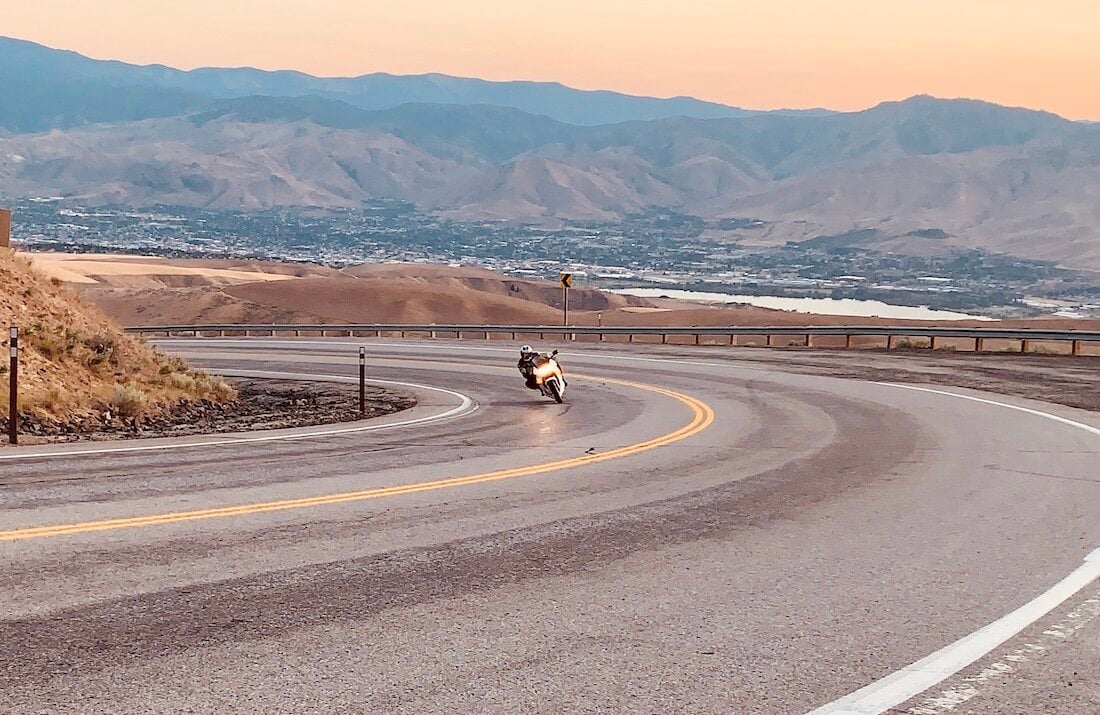
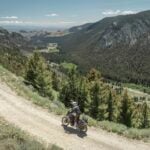
Making the ascent above Wenatchee, WA, carving some tasty curves.
At the end of the road at the summit I kill the engine and let The Unicorn catch her breath. Devoid of electronics she is at home here among nature’s high peaks, tall pines, cool mountain breezes and meandering summer morning clouds. The forested Pacific Northwest mountains surrounding her are analog just like she is, having survived for thousands of years without electronic assistance. Forests and their complex ecosystems require no sensors, no electricity, no computer management and no artificial intelligence- they just are. It makes me wonder who really needs all this electronic control.
And who is really being controlled.
Done being one with the forest I restart The Unicorn and on the way down rapidly upshift into her 6th gear at a plodding 25 mph, take my hands off the bars, raise my face shield and stand up in the saddle. Feet on the pegs and a subtle squeeze of the tank between my knees are my only contact points with the girl. Her stable, somewhat lazy steering means she doesn’t mind my stand up surfing antics. I spread my arms wide, let the wind hit my chest, filter through my jacket and fill my open face shield, drying my eyes as the cool mountain air works its way over my face, around my cheeks and past my ears. This is as close to unassisted flight as I will ever get, no airplane, no wings and barely any sound, just like my childhood dreams. And The Unicorn, this mythical creature, she is flying beneath me, bright white skin gleaming in the morning sun, piston heart beating lazily, rubber hooves plodding peacefully, mind at relaxed idle like mine. We are one and the same.
God I love this beast.
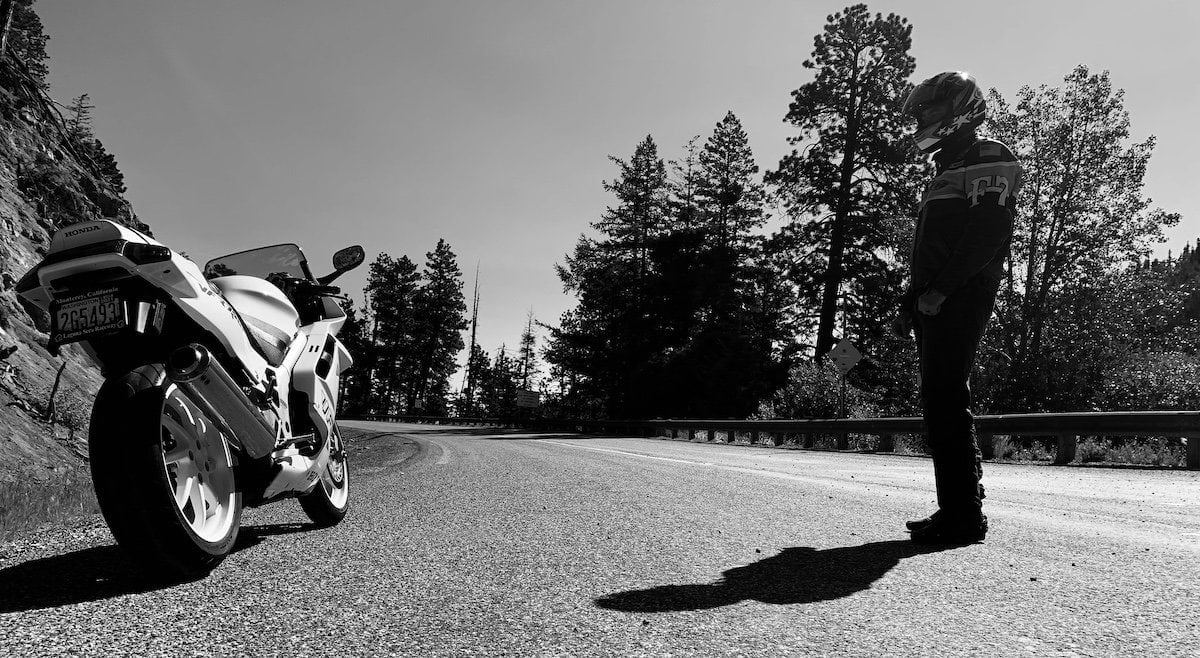
Ancient things look better in black and white.
No jerky fuel injection freaks out at my 25 mph 6th gear downhill coast, no IMU gets confused by my stand up balancing antics and no engine warning lights appear on the dash because, well, there are none. I am expected to correctly manage her because she is mine, wholly mine, every last bit mine to take care of, her control not shared by any electronic sensors, computer brain or bundles of wires. She does exactly what I want, when I want and how I want.
My Unicorn trusts me. For better or worse.
Back into town I park her on the street, grab coffee at my sidewalk cafe and stare at The Unicorn, her white skin dulled in spots by road grime. I have not washed her for months. Why? The dirt is a badge of honor, like a cowboy with calloused hands, an old Martin guitar with a worn finish or an ancient hot rod with patina. She is prettier this way, dirty, road grimy, proud. More warrior horse, less show pony. People walking by see her, stop, and stare.
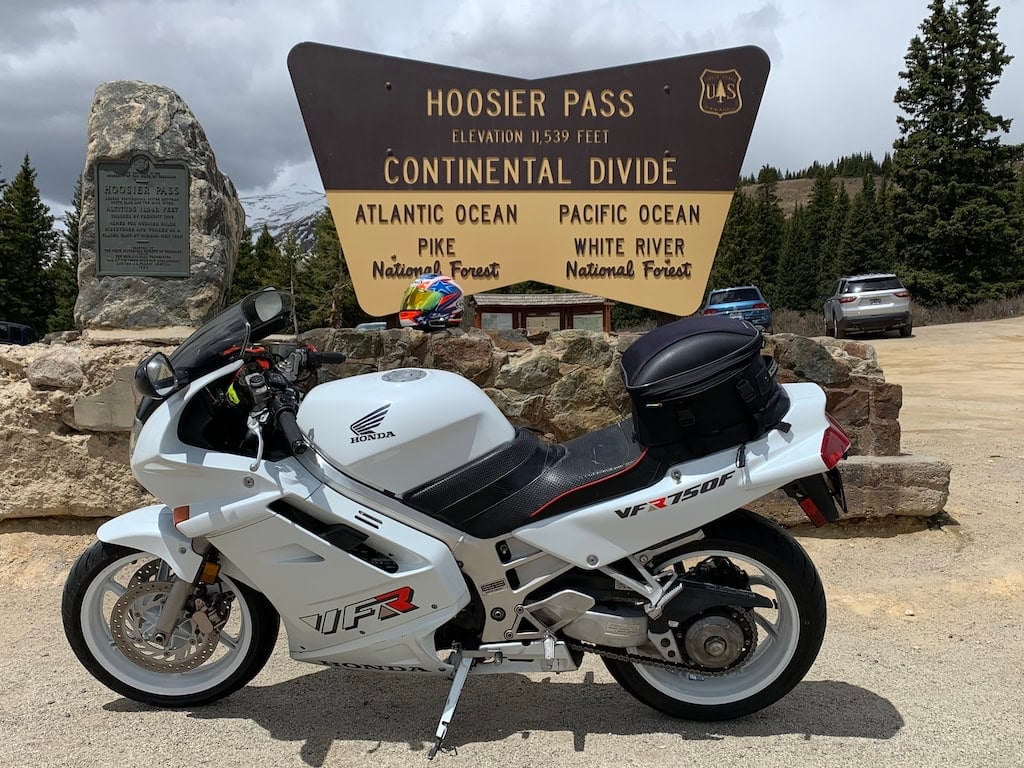
Continental Divide. She made me proud.
Civilians used to gangly giraffe suspension adventure bikes or loping buffalo herds of cruisers don’t quite know what to make of an over 30 year old fully faired sport bike in pearl white with streaks of road grime. They are transfixed.
Kids try to touch her. Moms try to pull them away before they get burned. Dads are too busy gawking at the bike to help mom. Old men stop and smile. Girlfriends get impatient with their boyfriends who won’t stop taking selfies. A few teenagers pry their pale digital faces from their phones, look up, and don’t quite know what to think because they are used to their electronic devices thinking for them.
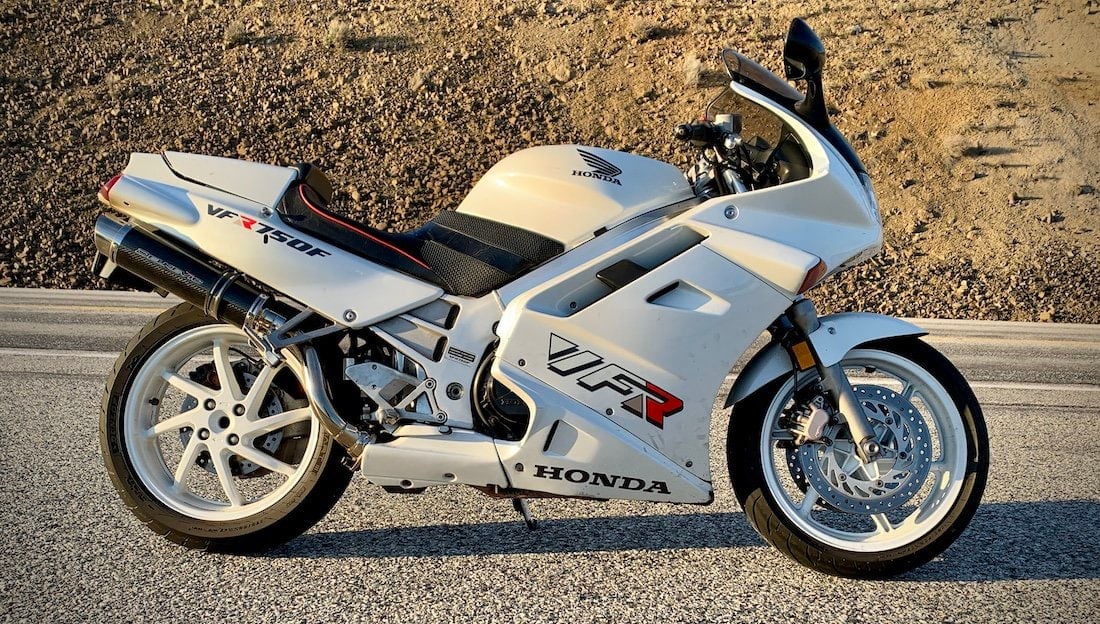
She is truly a mythical beast. At least to me.
Motorcycling is alien to their teen world, wasteful, unnecessary, deadly. Their cars don’t have carburetors, likely don’t require gas and may even drive for them. They think a sprocket is a nightclub, a swingarm is a yoga exercise and a carb is something to avoid eating. “Is that bike yours?” they ask. “Isn’t riding a motorcycle dangerous? Aren’t you afraid you are going to crash? How old is it? Does it have a real key? Is it supposed to be that loud? What is that smell? Is that the gas tank? And what is that ticking sound? Is it falling apart?” To them, this bike, its whole form and function, is from another planet.
They are right.
The Unicorn is not from our current electronic world. She is very real, built of cold steel, shiny aluminum, sticky rubber, smelly oil and volatile gasoline. She has chemical smells, makes loud sounds and projects an aura that draws a crowd. She is an endangered species that requires skill, experience, mechanical knowledge, a dose of strength, a dollop of concentration and sometimes just pure artistic touch. The Unicorn truly is a mythical beast, an analog alien on this digital planet.
Ted
*What bike helps you disconnect from the digital matrix, and reconnect with your own heart? Tell us in the comments below.


















Very nicely written! I have owned my ‘95 VFR750 for almost 30 years now and can identify with almost every word here. My VFR is still my favorite connection to my motorcycling roots.
Wow, that’s fantastic, Laura! Wishing you a Merry Christmas, and many more miles in the new year.
Mine too Laura. I have opportunities with Road Dirt to ride technologically advanced motorcycles, but when I feel the need to get back to why I ride, I saddle up The Unicorn.
Thanks for a fun article. I’ve owned four Interceptors (VFRs): an ’86 500, a 95 750, an 06 800, and a 14 800. I think my 95 was the generation after your Unicorn, but I can identify with almost every word of your article. I’ve read rumors that Honda is reviving the V4 and planning a new Interceptor/VFR. I hope the rumors are true and I’ll be beating a path to the Honda dealer. Thanks again.
Good to hear from you, Marco! Been a minute. We always enjoy your comments and thoughts. Glad you’re still with us.
We’d love to see Honda bring back the vaunted V4 VFR as well. Here’s hoping.
Another beautiful piece of magical writing. I’m well aware of the Unicorn but have never ridden one. Growing up in the 60’s and 70’s gave me multiple opportunities to experience early motorcycle technology first hand. I too enjoy the modern day comforts and conveniences of electronics, but there is something to be said and respected regarding yesteryear motorcycles and the raw mechanical devices that make them run.
Keep writing, Ted! Your gift allows the rest of us to experience places and thoughts we would otherwise never visit.