


The TV Series That Disappeared Too Soon
EDITOR NOTE: I vaguely remember as a kid my biker father occasionally watching a TV show about a guy riding his motorcycle around California. The bike was cool looking, even to this grade schooler, and the rider seemed like a nice guy in my young mind. Then it was gone, as the series disappeared from the screen and my memory. I’ve seen hints of it from time to time over the years, but I’ve never had the opportunity to view any of the episodes. I recently came across this commentary on the criticality acclaimed but sadly cancelled single-season series, and its piqued my interest again in Then Came Bronson. I can’t find the author of this piece, but credit goes to whomever it may be. This is eloquently and thoughtfully written. Enjoy.
In 1969, a man quit his job, threw a leg over his Harley, and rode away from everything- and an entire generation wanted to follow him. His name was Jim Bronson. And though he only existed on television screens for one brief, beautiful season, his spirit would outlive the show by decades.
Then Came Bronson wasn’t like other TV shows of its era. There were no shootouts, no car chases, no dramatic cliffhangers. Instead, it offered something rare: quiet rebellion. Each week, actor Michael Parks brought Jim Bronson to life- not as a hero, but as a seeker. A man who had looked at the American Dream, with its office walls and predictable routines, and simply said: “No, thank you.”
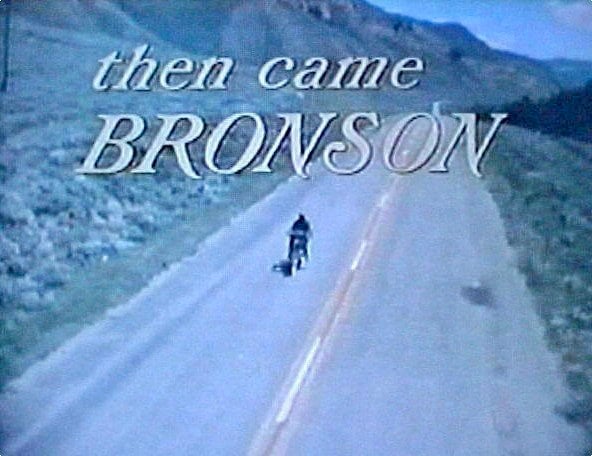
The series’ title card
The show opened with an unforgettable scene. Bronson, stopped at a red light on his Harley-Davidson Sportster, sits beside a businessman in a car. The man glances over and asks, “Taking a trip?”
Bronson replies, “What’s that?”
“Taking a trip?”
“Yeah.”
“Where to?”
Bronson pauses, then answers with perfect simplicity, “Wherever I end up, I guess.”
That exchange became iconic. It captured everything the show, and Bronson himself, represented: the courage to let go of certainty, to trade security for freedom, to trust the road more than the destination.
Week after week, Bronson rode from town to town, carrying only what mattered: a bike, a bedroll, and an open heart. He didn’t battle villains. He confronted questions. What does it mean to live authentically? How do we find connection in a disconnected world? Can freedom be found in movement, or only within ourselves?
In each town, he met people- drifters, dreamers, the lost and the searching- and through his gentle presence, he helped them find their own answers. He was a wanderer, but never aimless. A loner, but never cold. His journey wasn’t about escaping life, it was about finding it.
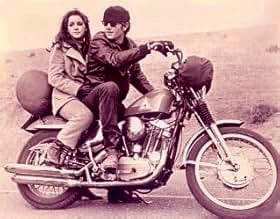
Bronson always got the girl- but couldn’t keep her.
The show resonated like a tuning fork struck at exactly the right frequency. This was 1969. Vietnam raged. Cities burned. The counterculture was in full bloom, and millions of young Americans were questioning everything their parents had built. Then Came Bronson didn’t preach or protest- it simply showed another way. A quieter revolution. One man, one motorcycle, one road at a time.
And America fell in love.
Harley-Davidson dealerships saw something they’d never seen before: young people flooding through their doors, asking for Sportsters just like Bronson’s. The motorcycle stopped being just a machine for rebels and outlaws- it became a symbol of possibility. Of choosing the journey over the job. Of trading the cubicle for the canyon. The open road wasn’t just a place anymore, it was a philosophy.
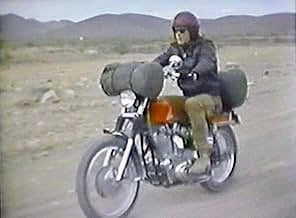
On the rare occasion he actually wore a helmet.
But the show didn’t last. Despite its passionate following, Then Came Bronson aired for only one season before being cancelled in 1970. Some say Michael Parks clashed with network executives. Others say the show was too countercultural, too quiet, too thoughtful for prime time. Whatever the reason, Bronson’s journey ended, at least on screen.
But the spirit? That never stopped riding.
For decades since, Then Came Bronson has lived on as a cult classic, passed down among motorcycle enthusiasts, wanderers, and anyone who’s ever felt the pull of the horizon. The show might have been brief, but its message was timeless: Freedom isn’t found in arriving. It’s found in the ride itself.

The shot that has always gripped my imagination.
Even now, more than 55 years later, Bronson’s presence is still felt: In every rider who chooses the back roads over the highway. In every person who walks away from what’s expected to chase what’s true. In every soul who looks at the open road and hears the whisper, “Wherever I end up, I guess.”
Jim Bronson never made it to any particular destination. That was never the point. He was always exactly where he needed to be- in motion, in the moment, in the searching.
And maybe that’s the freedom we’re all looking for.
-unknown
As of this writing, the series is not available for streaming anywhere, that we can find. It’s available to buy on Amazon on DVD and Blu-ray, apparently. A friend said he found a few episodes on the Dailymotion website. Here’s hoping someone will eventually dig it all up and share it on a streaming service.
















The “goin’ on a trip?” thing … when folks ask me I just say … Well, I’m goin’ up a ways and then turn left or right and go some more and turn left or right again … to no where in particular but always to some place special.” … The Old Man and the C
I like your “nowhere in particular but always to some place special.” Well-stated.
I’ve known about this show for years but had never seen it. After reading this, I watched an episode on the Dailymotion website. Captures the spirit of riding that existed before, then and till this day. Thanks for reminding me of it.
Yeah, planning to view what few episodes that site has as well.
Good to hear from you, Scott.
Bronson was an inspiration for me, as was ‘On Any Sunday’. It’s one of the reasons I wanted to ride. A few years ago I managed to find the entire series on DVD on Ebay. Although the video quality was on a par with Handy-Cam movie bootlegs, I watched every one. While taking a break from a day-long ride on my VFR I used the “Taking a trip?” dialogue with a kid in a Civic, although he didn’t know it.
Now I want to find the series on DVD! And have that opening scene dialogue with an unsuspecting cager myself, lol.