

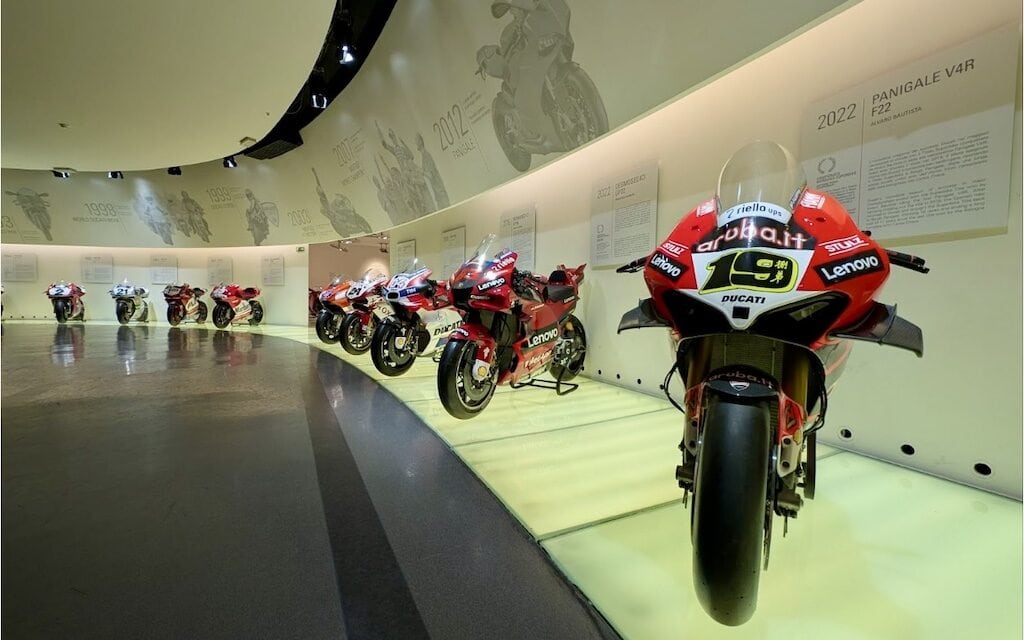

A Slice of Moto-Heaven in Italy
My wife and I took a trip to Italy and Spain recently, our first trip to either country and being a long time MotoGP and motorcycle racing enthusiast I had to take advantage of being in an area full of motorcycle racing talent, tracks and experiences. Our trip was over Christmas and New Years so with no races going on, I knew the one place I wanted to visit- the Ducati Museum in Bologna, Italy.
I must admit, I am not a “Ducatista”. They have never been my top choice of brand, but I love the way the bikes look and have always loved watching them race over the years, whether that be in World Superbike, multiple national championships (MotoAmerica, etc.), or MotoGP. Furthermore, being a fan of Marc Marquez, I loved seeing him get a fresh start with Ducati, topping things off with winning the MotoGP riders and Constructor’s championship in 2025.
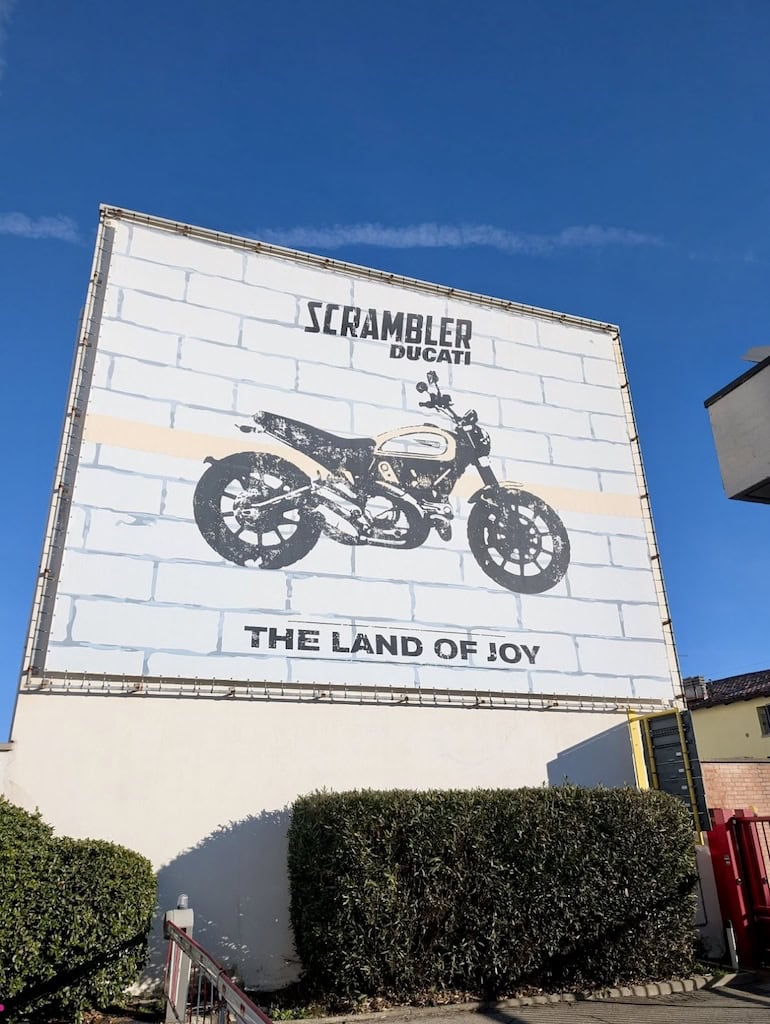
The grounds outside the museum set the stage for what you’ll see inside. Passion and attention to detail. From the clean white mural to the finely trimmed hedges.
As our Uber driver dropped us off at the gate, I immediately noticed a large mural of a Ducati Scrambler greeting us. The area felt a bit unassuming compared to what I had drawn up in my mind but thinking about it more, it made sense. Ducati does not need to make its presence known loudly, the bikes and results speak for themselves and the first impression was that of passion but also precision with a neat and clean appearance.
After scanning our tickets, we walked inside to the reception area and were greeted by several display models of the latest Ducati offerings: a Panigale V4R, Multistrada, Streetfighter, and Diavel. Guests are able to sit on each bike except for the Panigale. Surrounding the bikes were many trophies from Ducati’s many MotoGP triumphs over the years. My favorite design was definitely the British Grand Prix winners trophy for Francesco Bagnaia in 2022. The base included a clutch basket design and the center had a piston and track outline.
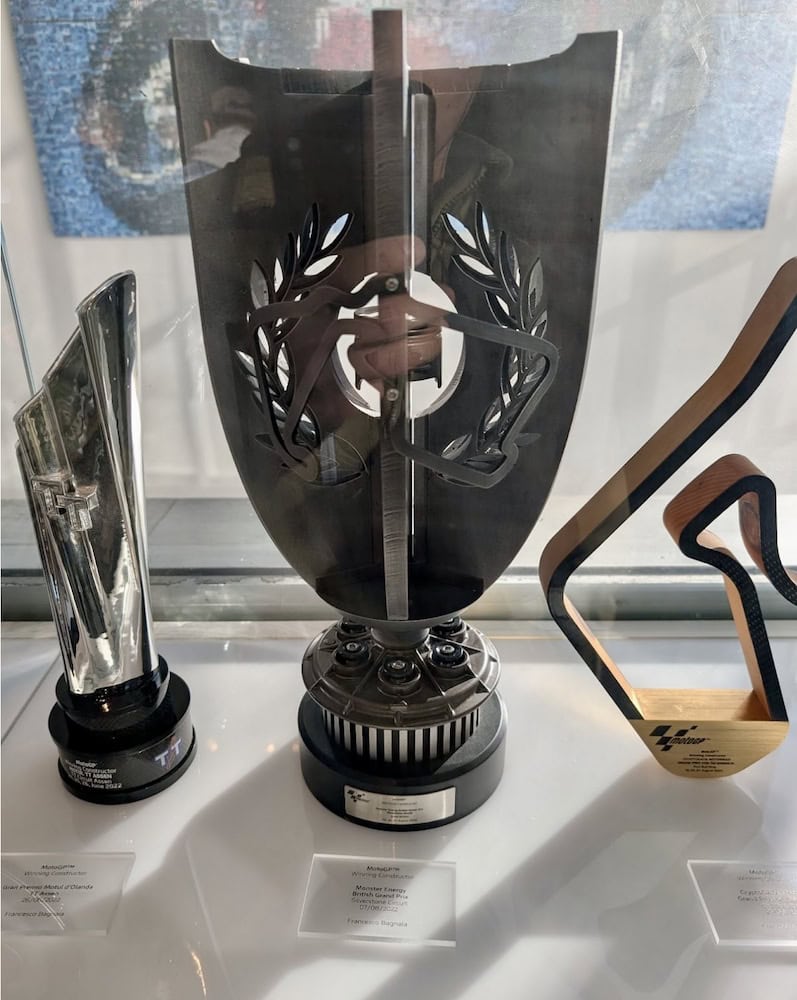
One of the many trophies on display throughout the museum. This one from the 2022 British GP was a particular favorite.
Once we got our official museum visitor badges from the receptionist we started our journey into the museum. We stopped at the first display which was that of a radio and electronic transmitters. I won’t go into too much detail but we learned that Ducati got its start as a company making short-wave radio transmitters in the 1920’s. The Ducati factory was destroyed during World War II but rebuilt post-war at a time when micro-engines were being fitted to bicycles for quick mobility. With that, Ducati started on the path to becoming a motorcycle powerhouse.
You can find out more information on Ducati’s history here.
As we moved further into the museum I saw a familiar sight I’d seen from many friends’ photos that have visited the museum in the past- a long curving row of racing motorcycles laid out in chronological order. Being a racer myself, this was the most exciting part for me to see but we noticed openings in the wall behind the motorcycles which told the story of Ducati’s road bikes. I wanted to save the best for last and was curious to learn more about Ducati’s history so we turned left and were greeted by a 1946 Cucciolo T1 engine, a 48cc 1.5 hp single that was fitted to a bicycle frame. The Cucciolo was the first motorcycle product assembled at Ducati so this was the start of what Ducati is today.
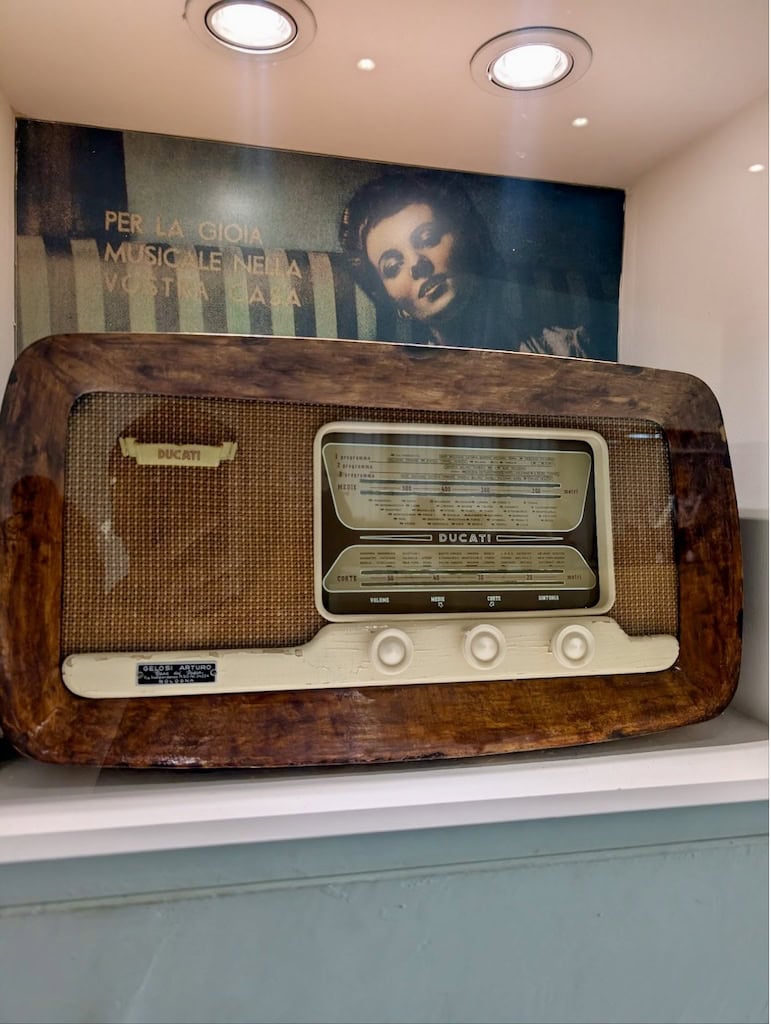
From radios to road bikes, Ducati started from very humble and non-motorbike related beginnings.
We continued on through the exhibits which had a clean, art gallery vibe. I stopped at each exhibit, reading thoroughly and taking photos of each one, carefully studying each motorcycle or engine model along the way. A lot of the motorcycles I’d seen or heard of but never knew their history, so it was great to find out more about why some of these bikes were considered such legends by those that have been around much longer than me.
The last road bike room we entered contained several motorcycles, but two of note for me. First is the Ducati Desmosedici, a MotoGP replica road bike released in 2006 that could give the owner a MotoGP experience for the street- if you had around $72,500 to spend. The second bike is one of the Ducati models I would love to own, a 1098. It’s been a long time since I’ve seen one in person and it was just as beautiful as I remember. The lines of the bike, from the trellis frame, aggressive front fairing, single sided swingarm and twin exhaust all flow together into a beautiful motorcycle. I looked at the 1098 for a few minutes and noticed a black and white drawing of one mounted above the bike.
I’m thinking both the bike and drawing would look great in my garage.
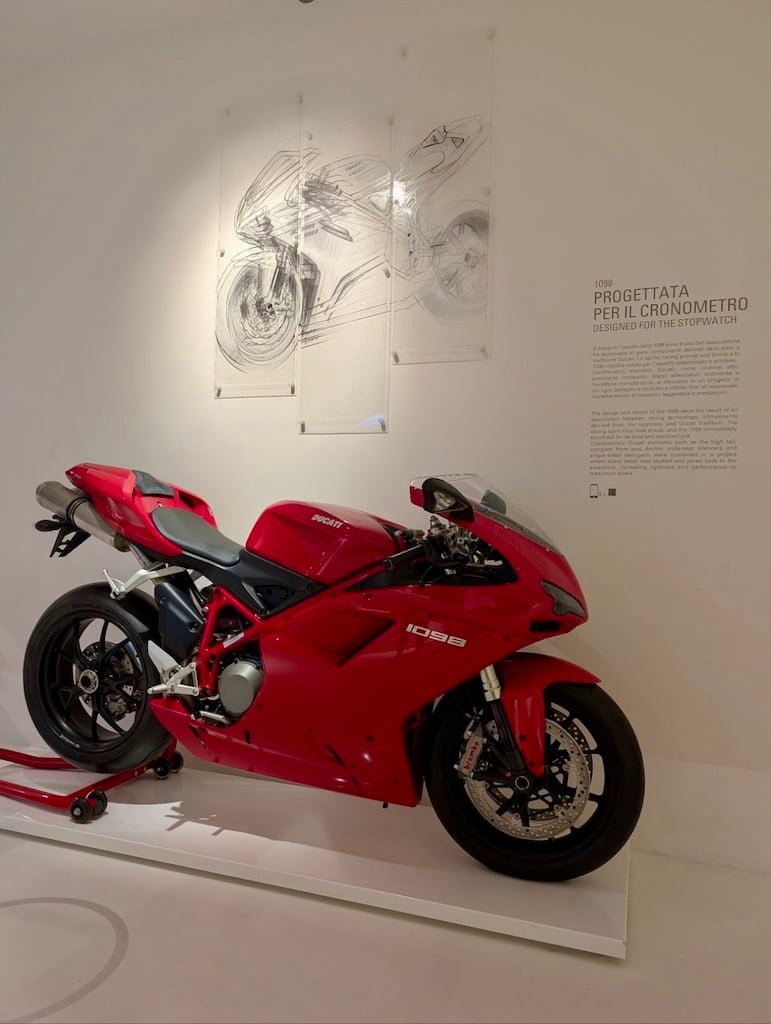
A Ducati I would love to own- the beautiful 1098. I wouldn’t mind that sketching above it either!
With our tour of the road bike history complete, it was time for the race bikes! As I mentioned before, I’ve had several friends visit the museum over the years and share photos so I knew one of my favorite GP bikes of all time was here, Casey Stoner’s 2007 Desmosedici GP07. However, I wanted to see everything, so we started at the beginning with a 1949 Cucciolo 50cc racing bike. It was impressive to think of Ducati’s start to where it currently stands, as a MotoGP powerhouse as we walked further through the years of Ducati racing history.
I am not going to detail each bike but will point out a few of my favorites. First, Troy Bayliss’ 2001 996 F01. The bike on display was a clean metallic silver, not the familiar Ducati red. The sparkle of the paint caught both my eye and my wife’s. Being a racer I was taking more time than most at each bike display, looking at small details like how they routed the brake lines, the layout of the controls, always trying to learn and get ideas on how to improve my own setup.
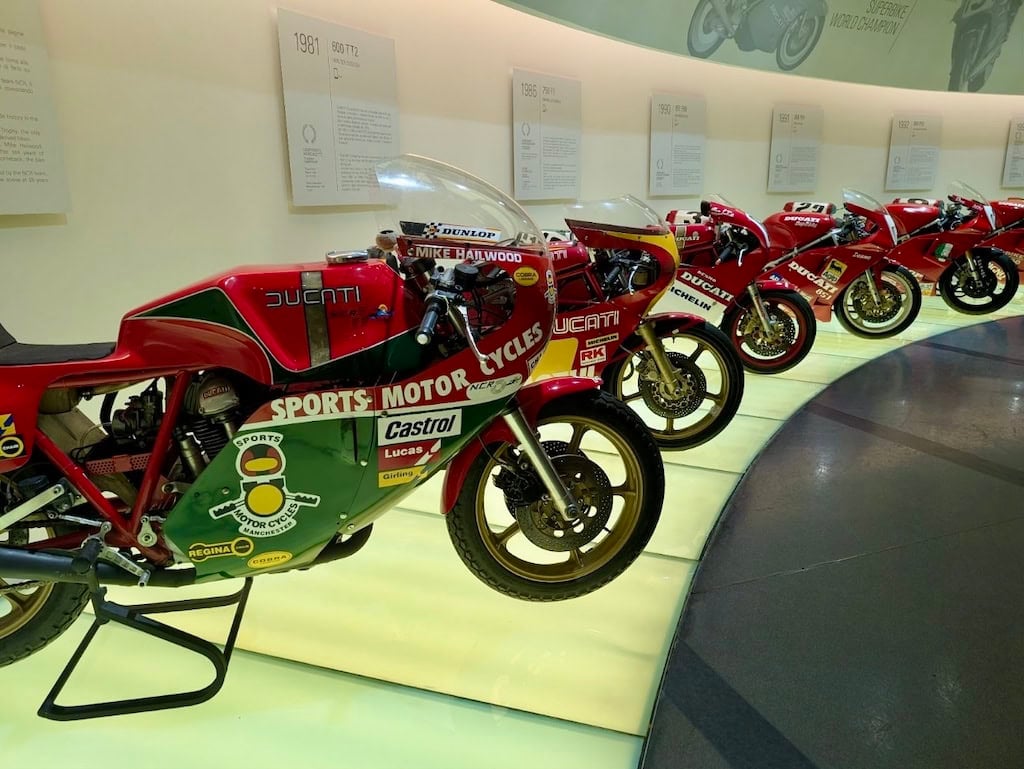
Ducati passion and racing history throughout the years was absolutely amazing to behold all in one place.
Another highlight for me was to see Neil Hodgson’s 2003 999 F03. I became a fan of Hodgson after hearing an interview with him at my very first AMA Superbike race. He had a really friendly personality and told a story of how he didn’t like the speed limit rules and police giving him speeding tickets in the United States versus in the UK.
Being a fan of the 1098, I have to mention another Troy Bayliss bike, the 2008 1098 F08 from his championship winning season in WorldSBK. That Xerox livery is iconic to me, so it will always hold a special place in my heart.
Before I discuss my favorite bike in the museum, I need to mention the last three bikes in the racing collection- Andrea Dovizioso’s 2016 Desmosedici GP16, Frenchesco Bagnaia’s GP22 and Alvaro Bautista’s 2022 championship winning Panigale V4R. Seeing these bikes in person was something else. The level of tech and detail taken on each bike was amazing to see. Noting the technology changes in bike design comparing Dovi’s 2016 GP bike to Bagnaia’s championship winning bike in 2022 was utterly fascinating to me.
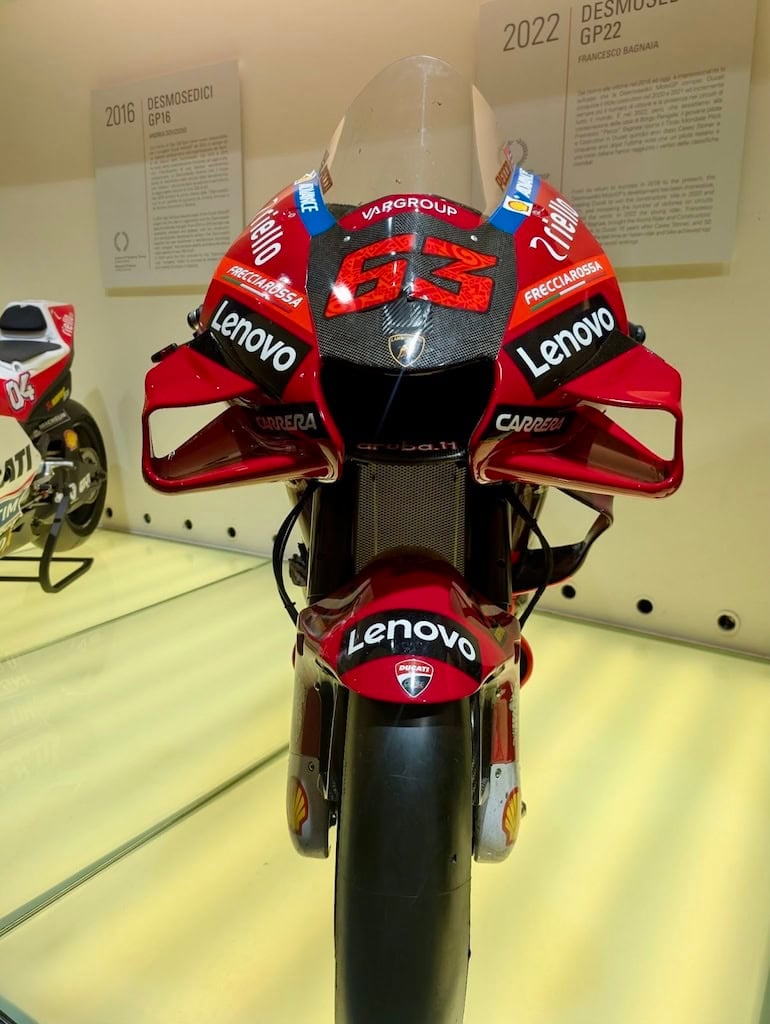
A closer look at Pecco Bagnaia’s 2022 Ducati GP machine. Note the missing winglets on the side of the bike.
The winglet design was really interesting to compare side by side with the much cleaner contained look on the 2022 bike compared to 2016. One cool thing about Bagnaia’s bike is the winglets on the right side were broken off, revealing how they were originally mounted. I appreciate Ducati choosing to leave this as-is, to give us a glimpse into the design and structure.
Also, comparing the GP bikes to Bautista’s WorldSBK machine was fascinating to see the similarities and differences between a production based bike and a prototype. Size wise they looked very similar, but the main differences obviously were in the fairing and aero design. You could see how Ducati does try to take some design elements from the GP platform and plug that into their road bikes. You read about it in marketing materials but seeing it shows these weren’t just some PR jargon.
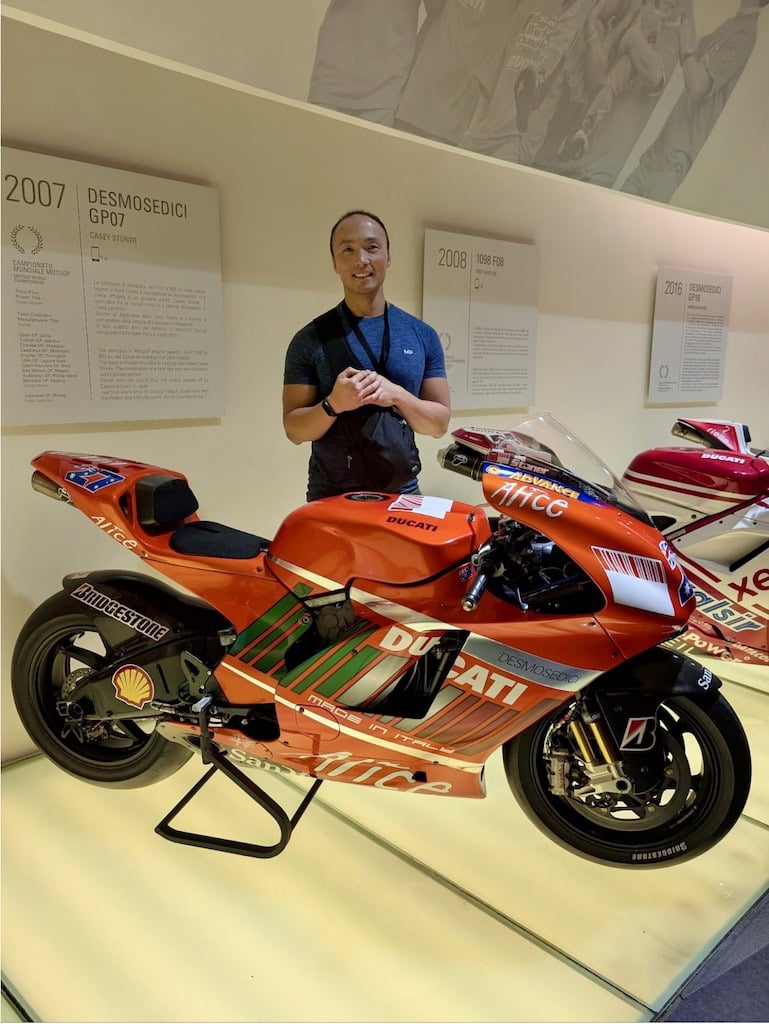
With my favorite motorcycle in the museum, Casey Stoner’s Desmosedici GP07. A special thrill.
Circling back to Casey Stoner’s GP07, it was my favorite motorcycle in the museum for many reasons. I’m a purist at heart and not a huge fan of the winglet designs of current GP bikes. Stoner’s bike is clean, with a smooth fuselage like a bullet. I remember seeing Casey struggle on the Honda before joining Ducati and his 2007 championship winning season on the GP07 will always be legendary. Until Bagnaia won the championship in 2022, no one else was able to ride a “Bologna Bullet” to a championship. That year made me a Stoner fan, so that is another reason I was so excited to see the bike in person. I spent more time gawking at that bike, taking photos of it and photos with it than any other bike in the museum. My wife shares my love of MotoGP but I know it’s not at the same level as me. Even so, she enjoyed seeing how happy I was and was very patient as I looked over every inch of the bike, studying it like an artist studies a painting.
After I’d finished looking at all of the bikes and taking nearly 500 photos in the museum, we slowly made our way back towards the start. At the reception desk was a large guestbook for people to sign. I noted the date, added our names and my racing number and then proceeded to check out the road models we were allowed to sit on before exiting. I sat on all of the available models there, the most unique one to me being the Diavel. I’m definitely not a cruiser guy, so sitting on a bike with my feet forward of my body is a foreign feeling. However, it was cool to see Ducati’s take on the cruiser lifestyle.
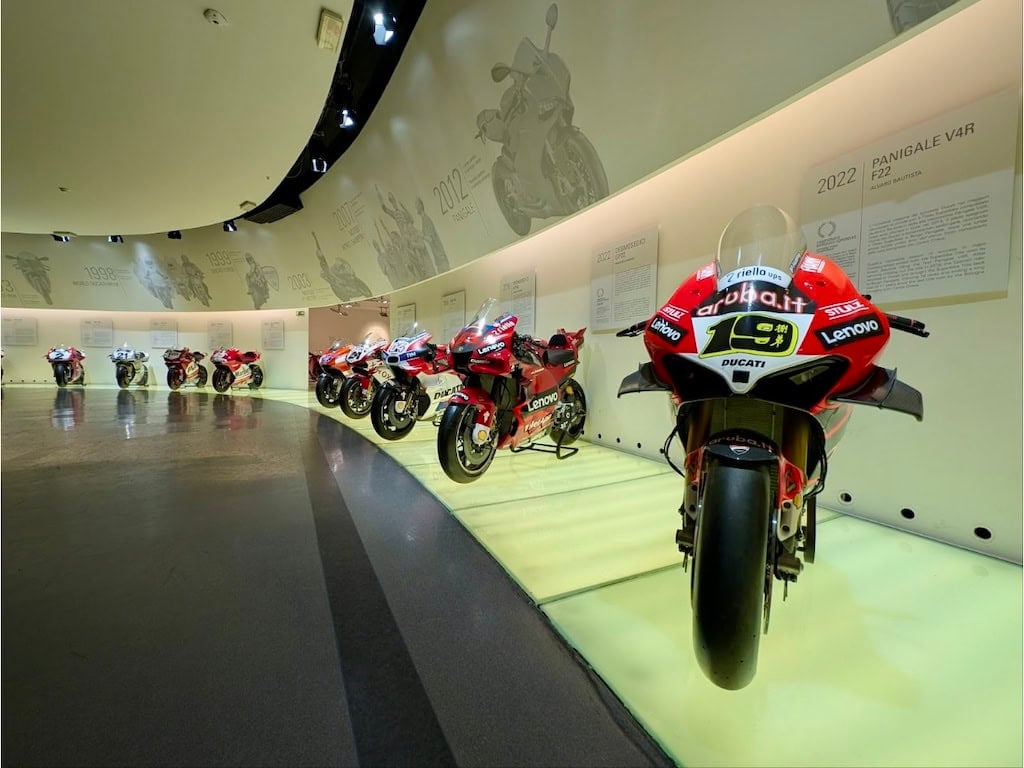
Something to satisfy from every area and genre of Ducati motorcycling.
After checking out the models, we made our way down the stairs and out of the museum to the gift shop. We had a look around and I decided to treat myself to one of the Mugello Anniversary team shirts from 2025. The Renaissance-inspired livery left an impression on me so after trying on the shirt, I had to have it.
As we made our way out of the grounds, I looked back at the museum and was left with a special feeling that we were able to experience something truly unique. Finding this slice of motorcycle heaven amongst the beautiful backdrop of the Italian town of Bologna and countryside surely enhances the vibe. I really can’t explain it in the right words but I think anyone who has been here can relate, the museum is something special and is definitely worth a visit. That’s coming from someone who doesn’t even consider himself a Ducatista. I’ve never owned a Ducati but after this visit, I have a feeling that might change sooner rather than later.
Ciao!
Ryan
For more on the Ducati Museum, click HERE.
*Please visit our sponsors and advertisers, below, above and across our pages. They help us keep the lights on.















Thanks for sharing your tour with us. I’ve never been to the museum, but somehow end up in Italy every few years or so. This will definitely be on my list next trip.
Ryan,
Great photos and story about the museum! Hope to see you this summer.
Dean
Hi Dean!
Hope we can catch up this summer, too!
Hi Rob!
Looking forward to seeing you too. I’ll call you soon.
Dean